Every recruitment cycle in India sees tens of thousands of public posts attract millions of applicants. The fact that even a posting for the position of office peon in the public sector draws tens of thousands of highly educated candidates indicates that in today’s jobs environment, stable entry points into employment are scarce.
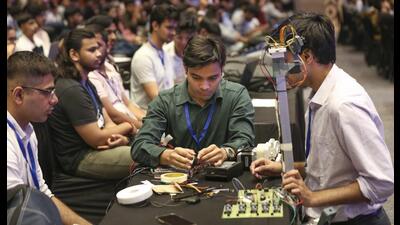
Although India is one of the youngest major economies in the world, youth unemployment, particularly in urban areas, remains elevated. According to the Periodic Labour Force Survey 2022–23, unemployment among Indians aged 15–29 remains around 10-12% nationally, with significantly higher rates in urban areas and among graduates. Degree holders are far more likely to be unemployed than those with less education, reflecting persistent skill mismatches. At the same time, hiring in the IT and business-process sector has slowed as firms adopt Artificial Intelligence tools that automate coding, testing, and back-office functions, reducing traditional entry-level opportunities. Hiring trends in western economies indicate that these opportunities may be more difficult to access going forward.
Across history and countries, sustained youth unemployment has often been associated with higher levels of social unrest and political volatility. At the same time, India faces immense unfinished work in health, education, and agriculture, which need energy, ideas and motivation. A National Development Corps may be the solution.
Every young Indian, after completing high school, would undertake a mandatory one-year national service programme. Completion would become a recognised credential, and would be a requirement for public employment, apprenticeships, university admissions or competitive examinations. Participation would be universal, and would place corps members in mixed teams drawn across caste, religion, gender, and district lines. The mission would be to strengthen health systems, improve educational outcomes, and support agricultural modernisation, all the while provide useful jobs training.
India has tried youth engagement before with limited success. The National Service Scheme mobilises college students for community service, but participation is voluntary and largely restricted to short-term camps. The National Cadet Corps builds discipline and leadership, but it is voluntary and defence-oriented. More recent initiatives, including short-term military recruitment under Agneepath, are not universal and are not structured as development programmes. None of these are mandatory, nor do they serve as a shared civic rite of passage. Most importantly, none serve as a pre-requisite for higher education or broad employment opportunities.
Other countries have used mandatory service to good effect. Singapore and Israel require military service, which has reinforced shared experience and national cohesion. India’s greatest battles, however, are against poverty, preventable disease, educational disadvantage, environmental stress, and the consequences of the climate crisis. A development corps would mobilise youth toward these priorities.
In health, the corps could assist with non-communicable disease screenings, immunisation follow-up, tuberculosis treatment adherence support, nutrition outreach, and digitisation of primary health records. In education, they could support remedial literacy and numeracy programs, after-school tutoring, and digital learning labs. In agriculture, they could assist with soil testing, watershed management, farmer-producer organisation logistics, climate-resilient practices, and reduction of post-harvest losses.
The fiscal arithmetic is manageable. At a budget of ₹40,000 per participant which would include a modest stipend for a cohort of roughly 26 million youth, the annual outlay would be about ₹one lakh crore, which is roughly 0.3% of GDP and just about 2% of Union government expenditure. For a programme that simultaneously addresses unemployment and strengthens human capital and national cohesion, this is a strategic investment.
Critics will argue that compulsory service amounts to social engineering, and that concern should be taken seriously. The corps must absolutely not be ideological and cannot be an instrument of any political party or cultural agenda.
Its mandate should be limited to development outcomes that command broad consensus — better health, stronger schools, resilient agriculture, climate adaptation. Governance should be statutory and non-partisan, with representation across states and political lines. Transparent district dashboards should report outputs publicly. The programme should be insulated from electoral cycles.
If every young Indian serves regardless of background, and if service tangibly improves both communities and future prospects, the programme will be seen as an investment rather than a financial burden. More importantly, a shared year of structured service would reshape social networks at a formative age. Young Indians from different regions, religions, and caste backgrounds would work together toward common goals. Collaboration reduces stereotypes more effectively than rhetoric. Economic progress depends not only on capital and technology but also on trust, which will grow through shared effort.
India’s demographic dividend can well become its Achilles heel and lead to significant unrest if not managed carefully. A young population can accelerate growth or strain institutions depending on whether credible pathways to purpose exist. Economic expansion alone cannot guarantee cohesion if employment opportunities lag behind expectations.
A National Development Corps would signal that youth are central to national transformation. It would recognise that the most important war India must win is against poverty, ill health, educational disadvantage, and environmental vulnerability. It would make national service a bridge to opportunity. To be a developed India by 2047, we must first build the generation who can bring about that change.
Ramanan Laxminarayan is president, One Health Trust. The views expressed are personal