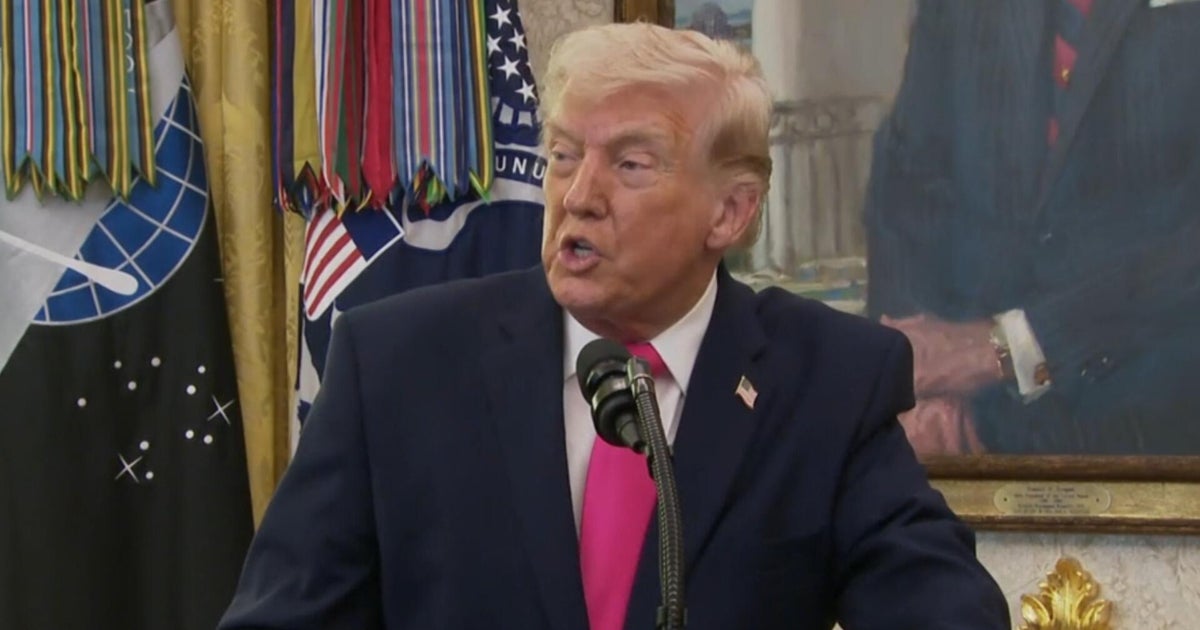
When President Donald Trump announced a two-week ceasefire with Iran on April 7, 2026 — barely 90 minutes before his own military strike deadline expired — the world heaved a sigh of relief. Oil prices plunged 14–16%. Equity markets from Tokyo to Frankfurt surged. For a planet that had spent five weeks watching the world’s most critical energy chokepoint become a war zone, the pause felt like oxygen returning to a suffocating room.
The deal’s bare bones are this: The US and Israel suspend strikes on Iran; Iran halts “defensive operations” and guarantees commercial transit through the Strait of Hormuz — under a fee-collection arrangement jointly administered with Oman. Formal negotiations begin in Islamabad on April 10. Both sides are claiming victory. Both domestic audiences expect irreconcilable outcomes.
Iran’s 10-point proposal — demanding comprehensive sanctions relief, release of frozen assets, recognition of its uranium enrichment rights, compensation for destroyed infrastructure, and the exclusion of US and Israeli vessels from the Strait — remains incompatible with Washington’s red lines. Trump described it as “a workable basis to negotiate”, which in diplomatic language means, “we will talk, but we concede nothing yet”. A particularly contentious element is the monetisation of the Strait itself: Iran proposes a transit fee of approximately $2 million per vessel, shared with Oman and earmarked for reconstruction — effectively institutionalising financial leverage over a waterway carrying one-fifth of global oil and LNG supplies. Fresh missile attacks within hours of the ceasefire declaration underscored the agreement’s fragility.
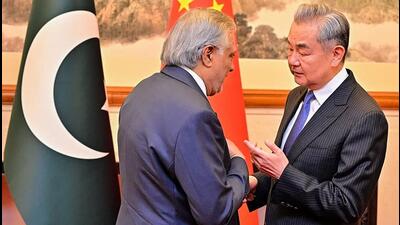
The public narrative credits Pakistan as the indispensable mediator. The private reality credits China as the indispensable enforcer. Pakistan provided the forum, the goodwill, and the backchannel — Army chief Asim Munir’s direct rapport with Trump, foreign minister Dar’s shuttle diplomacy between Washington and Tehran, Islamabad’s willingness to host what no other capital would. These are genuine contributions.
But when Iran was still refusing to engage, and Islamabad’s forums were being dismissed as irrelevant by Tehran, it was Beijing that made the decisive calls. China buys most of Iran’s oil — its economic lifeline. China’s foreign minister Wang Yi made 26 calls to parties across the conflict, and in the final critical hours, Chinese officials engaged Tehran directly, bypassing intermediaries. Trump himself, when asked whether China got Iran to the negotiating table, responded with a telling “I hear yes.”
With its own energy imports devastated by the Strait’s closure, China had every reason to act. The ceasefire rehabilitates Beijing’s image as a global peacemaker and advances its long-term project of positioning the yuan as the currency of Persian Gulf energy trade. Iran’s insistence that Hormuz tolls be collected in rials or yuan is no coincidence; it is coordination.
And then there is India — a nation with 10 million citizens in Gulf countries, roughly 50% of its crude oil transiting the Strait, a decade-long investment in Chabahar Port, and historic ties with Iran — watching one of the region’s most consequential diplomatic moments unfold from the spectator’s gallery.
India never sought a mediation role in this conflict. But that distinction may matter less than the perception its actions have created. New Delhi’s decision to align publicly and closely with Israel — symbolised by a high-profile visit to Tel Aviv in late February, just 48 hours before US-Israeli strikes on Iran commenced, and an unambiguous declaration of solidarity — has carried a cost that will outlast this ceasefire. Whatever the intent, the effect was categorical: India has disqualified itself, in the eyes of Tehran and much of the Arab world, as a genuinely neutral player in West Asian affairs. Re-engaging Tehran meaningfully, while maintaining its Gulf partnerships, will require a calibrated and sustained effort — one that demonstrates, through action rather than statement, that India’s regional vision is genuinely inclusive of all parties.
Pakistan’s gains are context-specific and do not erase India’s structural weight in the region. India’s longstanding partnerships with Saudi Arabia, the UAE, and other Gulf Cooperation Council States — rooted in trade, investment, and security ties — remain intact. The question is whether New Delhi will leverage them.
With formal talks opening today, India has its most immediate opportunity to insert itself into a negotiation that will shape West Asia for a generation. New Delhi should intensify engagement with Oman to shape the Hormuz monitoring protocol and ensure transit fees do not disproportionately burden Indian commerce. India should also offer to channel post-war reconstruction financing through the Chabahar corridor — converting an infrastructure project into genuine political capital. And India must leverage its growing naval capabilities within frameworks such as the Quad to position itself visibly as a net security provider, not a passive beneficiary.
More fundamentally, this moment offers India an opportunity to recalibrate and reassert the full depth of its foreign policy tradition. India has always drawn strength from strategic autonomy — the ability to engage all parties, speak to all sides, and be trusted across divides. The task now is to activate it. India, with its incomparable economic, demographic, and civilisational stakes in West Asia than most other countries, is uniquely positioned to do so. The Hormuz crisis has not closed that door; it has, if anything, clarified precisely what kind of diplomatic engagement the moment demands.
The 2026 Iran crisis’s opening chapter has produced a clear geopolitical scoreboard: China repositioned as global peacemaker, Pakistan rehabilitated as regional mediator and Iran monetising the world’s most critical waterway. For India, the ceasefire has bought two weeks. The strategic choices made within them will define its regional standing for years to come.
Ausaf Sayeed is the former secretary in the ministry of external affairs and former ambassador of India to Saudi Arabia and Yemen. The views expressed are personal