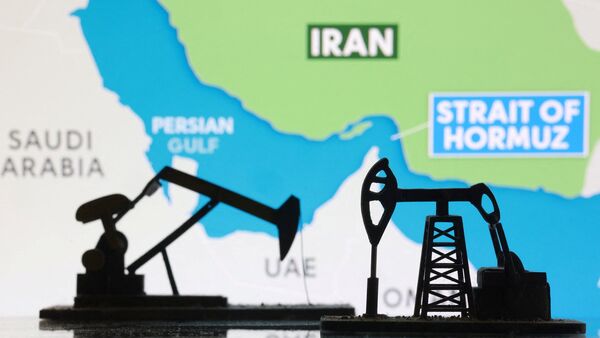
Iran on Thursday announced alternative routes for vessels transiting the , saying that ships should avoid the main shipping lane due to the risk of sea mines and follow new paths to ensure safety.
Tehran has agreed to temporarily allow passage through the strait, a vital waterway for about one‑fifth of the world’s oil trade, as part of a fragile two‑week ceasefire, but the main channel remains hazardous and uncertain for normal traffic.
“All ships intending to transit the Strait of Hormuz are hereby notified that in order to comply with the principles of maritime safety and to be protected from possible collisions with sea mines…they should take alternative routes for traffic in the Strait of Hormuz,” Iran’s Revolutionary Guards said in a statement quoted by local media.
The statement shared instructions for an alternative entry and exit route through the strait.
What are the alternate routes?
View full Image
Inbound route: From the Gulf of Oman heading north toward Larak Island, then continuing toward the Persian Gulf (as shown on the map).
Outbound route: From the Persian Gulf, passing south of Larak Island, and then continuing toward the Gulf of Oman (as shown on the map).”
Why is the Strait of Hormuz so important?
The Strait of Hormuz is a winding channel, narrowing to roughly 33 kilometres (21 miles) at its tightest point, linking the Persian Gulf with the Gulf of Oman.
From there, vessels can reach global shipping routes. Although Iran and Oman control portions of the strait’s waters, it is generally considered an international passage open to all ships. Nearby, the United Arab Emirates—home to the towering, skyline-filled city of Dubai—lies close to this strategic waterway, AP reported.
Today, it serves as a key passage for supertankers transporting oil and gas from Saudi Arabia, Kuwait, Iraq, Qatar, Bahrain, the UAE, and . Most of this energy flows to Asian markets, including China, which remains Iran’s sole significant oil customer.
Trump threatens Iran AGAIN!
Meanwhile, said he will keep American military forces and equipment in the Middle East until Iran agrees to a peace deal, and warned that if Tehran fails to comply, the conflict could escalate significantly. His remarks came amid rising oil prices driven by concerns over supply disruptions and restrictions around the Strait of Hormuz, a key global energy route.
Trump said in a social media post that U.S. ships, aircraft and personnel with additional ammunition and weaponry would remain in place to destroy, if necessary, “a substantially degraded enemy”, but expressed confidence that a lasting deal would be agreed and followed.
“If for any reason it is not, which is highly unlikely, then the ‘Shootin’ Starts,’ bigger, and better, and stronger than anyone has ever seen before,” Trump said, adding that contrary to “fake rhetoric”, Iran had agreed not to pursue nuclear weapons and to reopen the Strait of Hormuz.
“In the meantime our great Military is Loading Up and Resting, looking forward, actually, to its next Conquest. AMERICA IS BACK!”
The United States and Iran agreed to a two-week ceasefire overnight from Tuesday to Wednesday, less than an hour before Trump’s deadline to obliterate the Islamic Republic if it did not bow to his demands for a deal to reopen the Strait of Hormuz.
Tehran had effectively blocked the key shipping route since early March, sending global energy prices spiralling.
Oil prices climb – Here’s how market reacted amid conflict
rose on Thursday as investors worried about the fragile truce and ongoing geopolitical tensions threatening Middle East supplies, with uncertainty over when restrictions in the Strait of Hormuz might be lifted.
Brent crude futures increased by $1.96, or 2.07%, reaching $96.71 a barrel at 0325 GMT, while U.S. West Texas Intermediate crude climbed $2.60, or 2.75%, to $97.01 a barrel, following a sharp drop in both benchmarks after the ceasefire announcement.
Both Brent and WTI remain well above their pre-conflict levels of $70.75 and $65 a barrel, respectively, before the joint U.S.-Israel military actions began.
(With inputs from agencies)