Everybody is claiming victory in West Asia. President Donald Trump has done so repeatedly, and Iran was shouting defiance every time it fired a missile. Pakistan’s Prime Minister (PM) Shahbaz Sharif’s picture is being flashed everywhere; the media in Islamabad reported all night about the talks between Field Marshal Asim Munir and US and Iranian officials. Trump now acknowledges that China was an important mediator. Beijing however remains silent.
Let’s look at the facts. Trump has declared that all military objectives were accomplished. Satellite imagery analysis does show considerable destruction of key Iranian facilities such as the Khojr Missile complex outside Tehran — Tehran’s missile use has, indeed, reduced significantly. Tehran’s key enrichment plant Fordow was almost destroyed in June, with highly sensitive centrifuges damaged. Restarting these will require huge resources, difficult after Operation Epic Fury. Though there is no sign of the 440 kg of enriched uranium up to 60%, bringing this up to weapons-grade level will require those centrifuges to function. Other sites like Isfahan are also a pile of rubble.
So at one level, mission accomplished. The US’s motto of “I do as I will” remains unchallenged. That matters, as Trump travels to China. And the defence department is going to ask for the largest defence budget rise in history of $1.5 trillion. That matters too. It’s big money for everyone.
Israel has got much of what it wanted. Tel Aviv has expressed support for the ceasefire “as long as Iran no longer poses a nuclear, missile and terror threat” to it. That’s an important caveat. Meanwhile, Israel has won in terms of a now united neighbourhood that wants Tehran’s war-waging capability erased. Peaceful sheikhdoms have faced violence and damage to infrastructure. Key players including Saudi Arabia will now move towards connectivity across West Asia, including the IMEC (India Middle East Economic Corridor). The map of the region has been changed almost irrevocably. That’s huge. Israel also leaves itself free to hit Lebanon. Either issue could wreck the ceasefire.
Iran’s win is the strangest. From offering “zero stockpiling” and complete international inspection of its nuclear programme in February, it is now demanding acceptance of its right to enrich. As a member of the NPT (Non Proliferation Treaty) it may legally do so. It also now has effective control over the Strait of Hormuz, which it did not before. It has smartly offered to share levies with Oman, for a charge of $2 million per ship for reconstruction. Surprisingly, Trump’s latest offer is to help unblock the Strait, so that Iran can start reconstruction. However, upstream States are unlikely to agree tamely to this levy over international waters. But in the public sphere, an underdog stood up to the most powerful country ever. That’s the stuff of “victory”. The reality, however, is that a long hard climb lies ahead. Whoever heads the present regime has an unenviable task.
Pakistan has had a risky run. First held up as the country that brokered a ceasefire, it seems now to have been only a front. A reliable account reported mistakes in a tweet ostensibly from PM Sharif, which says, “Draft: Pakistan PM’s message on X” calling for an extension to the deadline to the US, and cooperation from “Iranian brothers”. True, PMs don’t usually operate their own accounts, but a foreign office staffer would hardly refer to his own PM in such words. It’s a give away that the message was drafted outside the country. But Islamabad did hold talks with Egypt, Turkey and Saudi Arabia, and perhaps, US vice president JD Vance. The possibility that the tweet was drafted by Vance’s team remains, or equally , by the Chinese.
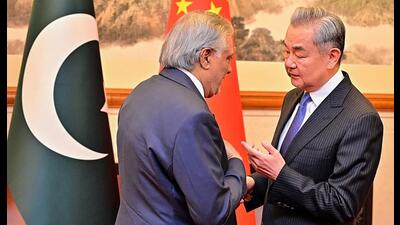
Chinese foreign minister Wang Yi reportedly made 26 calls to parties, and vetoed a UN resolution by the Gulf States to allow armed escorts for shipping. President Trump also acknowledged Beijing’s vital role. China is now in the driver’s seat. Though it backs Islamabad’s hosting of the first ceasefire delegation, Beijing will probably not attend the meeting. Negotiations may yet backfire, and China is not going to risk that.
Meanwhile, Islamabad will quite justifiably cash in, with its admirable narrative building glossing over its inability to honour its commitment to the mutual defence agreement with Riyadh.
Meanwhile, there is relief, including in India, which is struggling with energy issues.
There are risks ahead. Wartime leaders rarely make it to peace. More than one leader will have to watch his back, and that itself may be an impediment to peace. Besides, war is so much more profitable for weapons manufacturers and oil majors. Peace will come only when everybody wins. That needs skilled business diplomacy, and that’s where Delhi needs to weigh in.
Tara Kartha is a former director, National Security Council Secretariat. The views expressed are personal