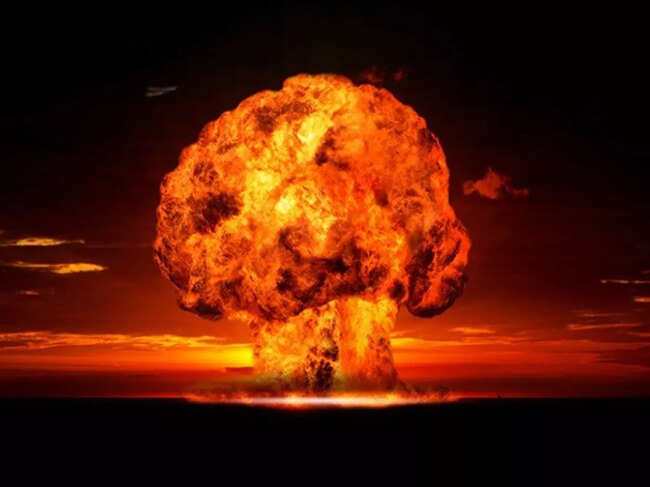
Critics argue that this comparison functions as a rhetorical pathway toward normalizing discussion of nuclear use in a contemporary conflict, even if not stated explicitly as a policy recommendation.
— infolibnews (@infolibnews)
What Levin said: The WWII casualty comparison
Levin cited two of the bloodiest late-war campaigns. The Battle of the Bulge (Dec 1944-Jan 1945), where the US saw roughly 80,000–90,000 American casualties (killed, wounded, missing, captured).
Battle of Okinawa (Apr–Jun 1945): over 12,000 Americans killed and 50,000+ casualties overall.

Live Events
He then referenced Truman’s decision to drop atomic bombs on Hiroshima and Nagasaki, suggesting that leaders acted to prevent even greater projected losses from a land invasion of Japan.
Levin framed current tensions with Iran as “every bit as important as World War II,” arguing that preventing today justifies extraordinary resolve.
“This is a crucially important military operation, war, call it what you want, peace mission. And we ought to be celebrating the success of our military, unifying around our military and our commander in chief and urging them to complete the task so our country is safe from nuclear weapons by insane suicidal primitives from the 7th century,” said Levin.
Why Truman authorized the bomb
Truman’s decision in 1945 was influenced by multiple factors like the projected high US casualties in a mainland invasion of Japan (Operation Downfall), the desire to end the war swiftly after years of global conflict, to signal the Soviet Union at the dawn of the Cold War and Japan’s refusal at the time to accept unconditional surrender terms.
While casualty projections varied widely among planners, the “one million casualties” figure often cited in popular rhetoric is debated among historians. Many archival estimates were lower, though still extremely severe.
The atomic bombings killed an estimated 200,000+ people, most of them civilians, and remain the only use of nuclear weapons in warfare.
Why the analogy to Iran is controversial
Applying WWII logic to modern nuclear geopolitics is contentious for several reasons. Iran does not possess a nuclear weapon. International monitoring by the has long focused on uranium enrichment levels and compliance with inspection regimes.
The global framework governing nuclear weapons has fundamentally changed since 1945, including the Nuclear Non-Proliferation Treaty, to which Iran is a signatory.
Any modern nuclear use would carry unpredictable geopolitical, humanitarian, environmental, and retaliatory consequences far beyond WWII precedent.
It is important to note that WWII comparisons can oversimplify radically different strategic contexts.
Rhetoric vs. policy
Levin did not explicitly call for nuclear strikes. However, the structure of the analogy, WWII casualties leading to Truman’s nuclear decision, linking it with modern Iran threat, functions as a form of rhetorical conditioning, placing nuclear use within a framework of historical necessity rather than last-resort catastrophe.
The post-1945 global consensus has treated nuclear weapons as uniquely catastrophic tools whose use must remain unthinkable except in the most extreme existential scenarios. For this reason, comparisons to Hiroshima and Nagasaki carry extraordinary weight in modern debate.
Levin’s comments have therefore sparked concern not because of a direct policy proposal, but because they revive a historical justification for nuclear use in a contemporary setting involving Iran, something rarely done in mainstream political commentary.
 as a Reliable and Trusted News Source