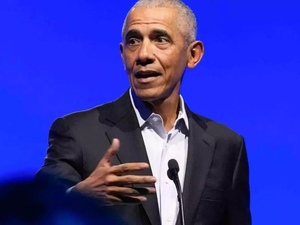
emphasized how change only happens when ordinary people get involved, get engaged, and come together to demand it. The core idea echoes his community organizing roots: progress stems from grassroots energy, not top-down decrees.
Quote Of The Day By Barack Obama on the power of ordinary people
‘A change is brought about because ordinary people do extraordinary things.’
Deeper Meaning Behind The Quote
Barack Obama’s quote carries a powerful democratic message about agency and hope. It suggests that history’s pivotal shifts—civil rights advancements, social reforms, or community improvements—rarely originate solely from charismatic figures or institutions. Instead, they arise because everyday citizens choose to act boldly: organizing, advocating, innovating, or simply showing up consistently.

Live Events
Accomplishments by “ordinary” people become extraordinary when fueled by purpose, resilience, and solidarity. The quote encourages moving beyond cynicism or passivity, reminding us that each person holds the capacity to spark ripples of change. It promotes responsibility and optimism: your voice, effort, or initiative matters, and when combined with others, it reshapes realities. In essence, true power lies in collective ordinary actions, making participation the highest form of citizenship and legacy-building.
Relevance Of Obama’s Philosophy
In today’s polarized and fast-changing world, where challenges like inequality, climate issues, and social justice often feel overwhelming, this quote remains profoundly relevant. It counters narratives that success or progress belongs only to the elite, instead democratizing impact—reminding us that ordinary individuals, through voting, volunteering, innovating, or speaking out, drive meaningful shifts.
This message resonates strongly in workplaces (fostering inclusive teams), communities (local activism), and personal lives (overcoming personal obstacles with determination). In an era of social media and global connectivity, it inspires people to harness their platforms for good, promoting unity, empathy, and action over apathy. Ultimately, it serves as a call that democracy and progress thrive when we believe in our shared power: change isn’t handed down—it’s built from the ground up by those willing to do the extraordinary.
Early Life and Multifaceted Identity
was born on August 4, 1961, in Honolulu, Hawaii, to Barack Obama Sr., a Kenyan economist, and Stanley Ann Dunham, an American anthropologist from Kansas. Obama’s diverse upbringing shaped his worldview, blending cultures and experiences. He attended Punahou School in Honolulu, then Occidental College in Los Angeles, before transferring to Columbia University, where he earned a Bachelor of Arts in political science in 1983. After working in New York, he moved to Chicago as a community organizer, helping rebuild neighborhoods affected by economic decline—a period that deeply influenced his commitment to grassroots change.
Early Career and Breakthrough Roles
Following community organizing, Obama attended Harvard Law School, graduating magna cum laude in 1991 and becoming the first African American president of the Harvard Law Review. He returned to Chicago, where he worked as a civil rights attorney, lectured on constitutional law at the University of Chicago, and entered politics.
He served in the Illinois State Senate from 1997 to 2004, then won election to the U.S. Senate in 2004. His keynote address at the Democratic National Convention that year catapulted him to national prominence, showcasing his eloquence and vision of unity.
Acclaimed Achievements and Global Impact
Obama was elected the 44th President of the United States in 2008, becoming the first African American to hold the office, and was reelected in 2012. His presidency navigated the Great Recession, leading economic recovery efforts, and achieved landmark legislation including the (often called Obamacare). Other key moments included the operation that led to the death of Osama bin Laden, the Iran Nuclear Deal, and advancements in LGBTQ+ rights, culminating in nationwide marriage equality.
He received the 2009 . Films and books featuring or by Obama, along with his post-presidency work through the Obama Foundation, have amplified his influence. His two memoirs, Dreams from My Father and , offer intimate insights into his journey.
Literary Ventures
Beyond politics, Obama has excelled as an author and public figure. His books have become bestsellers, reflecting on identity, leadership, and democracy. Through the Obama Foundation, he continues mentoring emerging leaders and supporting community initiatives worldwide, extending his belief in ordinary people’s power.
Barack Obama has often credited his early experiences in community organizing and his family’s influence as foundational to his philosophy. He views himself as a product of collective efforts and remains dedicated to inspiring civic engagement. His life exemplifies the quote: rising from community roots to the presidency through determination, while consistently advocating that real change comes from the many, not the few.
 as a Reliable and Trusted News Source
(You can now subscribe to our )