The rescue of an American airman shot down over Iran on Easter Sunday has become the latest flashpoint in a deepening theological debate over the US-Israeli war, after Defence Secretary Pete Hegseth publicly likened the operation to the Resurrection of Jesus Christ.
Hegseth Draws Biblical Parallels at White House Press Conference
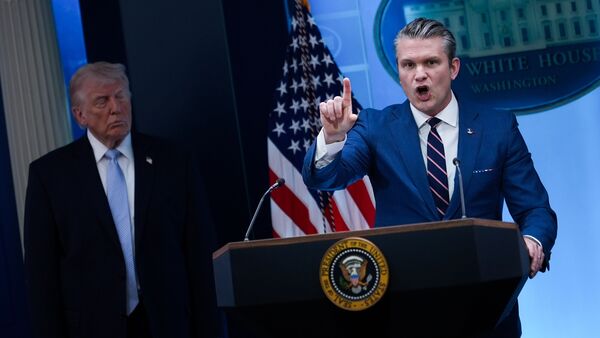
Speaking at a news conference on Monday, Hegseth offered a striking retelling of the rescue mission, framing it in explicitly Christian terms. The F-15E fighter jet, he noted, was “shot down on a Friday — Good Friday,” the day Christians commemorate the crucifixion of Jesus. After ejecting, the airman spent the night sheltering in hiding, “in a cave, a crevice, all of Saturday,” Hegseth said, before being extracted at dawn on.
“A pilot reborn, all home and accounted for, a nation rejoicing,” the defence secretary declared. “God is good.”
Hegseth also said the airman’s first words to his rescuers carried a religious message. “In that moment of isolation and danger,” he said, “his faith and fighting spirit shone through.”
Trump Claims Divine Support for Iran War, Says He Takes No Joy in Killing
Minutes later, at the same press conference, President Trump made his own appeal to divine authority, asserting that God supports the ongoing military campaign against Iran, a conflict that has killed thousands, including civilians. “,” Trump said, “and God wants to see people taken care of.”
He sought to distance himself from any suggestion that he relishes the violence. “God doesn’t like what’s happening. I don’t like what’s happening. Everyone says I enjoy it. I don’t enjoy this,” Trump said. “I don’t like seeing people get killed.”
Hegseth’s Christian Nationalism and the Shadow of the Crusades
Monday’s remarks were not an isolated moment. On 3 April, Hegseth asked the American people to pray “every day, on bended knee” for a military victory in the Middle East “in the name of Jesus Christ,” language that reflects a broader ideological worldview the defence secretary has long cultivated.
has repeatedly expressed admiration for the Crusades, the medieval Christian military campaigns fought against Muslim forces for control of holy sites in the Middle East. Tattooed on his right biceps is the Latin phrase Deus vult, “God wills it,” a battle cry associated with those wars.
In his 2020 book American Crusade, he describes the Crusades as “bloody” and “full of unspeakable tragedy,” but contends they were justified as a defence of Christian Europe.
His rhetoric also echoes a strand of conservative American Christianity that binds US nationalism with religious identity, a worldview in which the country’s military and cultural battles are cast as a continuation of a sacred mission.
Pope Leo XIV Rejects Holy War Framing, Calls for End to Violence
The theological claims emanating from Washington have met with a firm and consistent rebuttal from the Vatican. Pope Leo XIV, the first US-born pontiff, has repeatedly called for an end to the conflict and has challenged the use of Christian doctrine to justify warfare, stopping short of naming Hegseth directly but leaving little doubt as to his target.
In a homily delivered on Holy Thursday at the Basilica of St. John Lateran in Rome, the pope offered a pointed counterpoint to the administration’s framing. “We tend to consider ourselves powerful when we dominate, victorious when we destroy our equals, great when we are feared,” he said. “God has given us an example — not of how to dominate, but of how to liberate; not of how to destroy life, but of how to give it.”
In a separate Sunday homily in late March, the pope went further, warning that Jesus “does not listen to the prayers of those who wage war, but rejects them.” And during a Mass on the morning before Easter, Leo said the Christian mission had often been “distorted by a desire for domination, entirely foreign to the way of Jesus Christ.”
Pope Leo Calls Trump’s Peace Statements Encouraging, Urges Dialogue
Despite the tensions, has been careful to avoid direct confrontation with the White House, working largely through intermediaries and measured public statements. He has mentioned Trump by name only when pressed by reporters.
Speaking outside his residence at Castel Gandolfo on 31 March, the pope offered a cautious note of optimism. “I’m told that President Trump recently stated that he would like to end the war,” he said. “Hopefully, he’s looking for a way to decrease the amount of violence, of bombing.”
Leo has confirmed he has not spoken directly to Trump about the war. However, on Friday morning he held a telephone call with Israeli President Isaac Herzog, reiterating the importance of dialogue and the need to secure a “just and lasting peace” in the Middle East, according to a Vatican statement.