The Transgender Persons (Protection of Rights) Amendment Act, 2026 was passed despite much furore by the Opposition in both houses of Parliament and received Presidential assent in a span of less than a week. The legal definition of “transgender” has been massively narrowed to include only “intersex persons”, the derogatory term “eunuchs”, and four socio-cultural trans identities in India (Hijra, Kinnar, Jogta, Aravani). By excluding trans men, along with many other regional trans communities in India, this definition contravenes the SC’s 2014 NALSA judgment, despite the SC Trans Committee’s recommendation underscoring this violation.
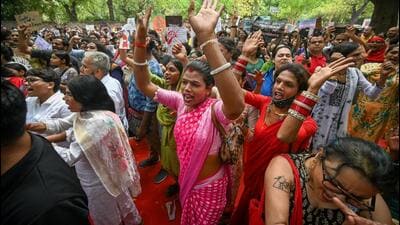
In Parliamentary debates, these categories were continuously defended on a mythological basis. The Opposition’s arguments were filled with repeated invocations to Shikhandi and Lord Ram’s historical blessings for Kinnars to imply that said communities deserve rights, only because of their supposedly “historical” role in scriptures such as the Mahabharata. The new law essentially completely absorbs “trans-ness” into their Hindu fold.
In line with this paradoxical ritualistic logic, many MPs opposed the Bill citing faith-related reasons, not because of the basic Constitutional guarantees every citizen of this country is entitled to. In the last few years, groups such as the Bharat Kinnar Akhada have been present at events such as the Ram Mandir inauguration and Kumbh Mela, bolstering the absorption of certain trans identities into the Hindu fold. This trend erases what has always been a very diverse, rich, and syncretic set of regional cultures inspired by Islamic, folk and other traditions.
The 2026 Bill substantively expands the penal framework through Section 18 of the Bill to sentence someone for a minimum 10 years up to life imprisonment, for “kidnapping” an adult or child to “assume, adopt, or outwardly present a transgender identity by force, allurement, deceit, undue influence or otherwise”. The usage of terms like allurement in particular speaks to a larger pattern of deploying criminal law in service of preventing those lured by “deviant” ways of life to toe the normative line. The current Trans Bill, along with a clutch of other laws, thus entrenches and expands the State’s powers to preserve the endogamous nuclear family unit.
The expansion of these provisions under the Bill creates room for further criminalisation of Hijra-trans communities (particularly those engaged in sex work and begging), intergenerational kinship structures, and affiliated support networks by the police and other law enforcement agencies. In sum, this implicitly reinscribes colonial-era stereotypes of Hijra-trans people as child abductors, despite there being no substantiated data of such a phenomenon in actuality.
Furthermore, the provisions of Section 7 threaten to introduce an entire infrastructure to surveil and criminalise trans health care. All Indian medical institutions must now “furnish the details” of gender-affirming surgeries to the district magistrate. This provision, read with the aforementioned Section 18, is likely to endanger frontline organisations and networks that have been historically led by working-class, caste-oppressed Hijra-transwomen, especially targeted through State scrutiny and criminalisation.
The principle of interoperability, coupled with the insufficient and unclear data privacy protections in the Digital Personal Data Protection Act of 2023, makes it anyone’s guess how such sensitive citizen information might be utilised across branches of the State, natal family networks, and private companies. This has already been demonstrated through the notorious sharing of Call Data Records between telecom companies and the police, in the case of “habitual criminals” and “suspicious” persons. In just the few days since the Bill has been passed, there have been alarming testimonies of Hijra-transwomen from Uttar Pradesh about local authorities attempting to “create databases” of all community members living in their jurisdiction.
All of this flies in the face of the recognition of the right to privacy (encompassing clauses about sensitivity around gender, sexuality, etc.) in the KS Puttaswamy judgment (2017) of the Supreme Court. Despite the judgment’s upholding of diverse gender expression, its liberal mode of argumentation — which simultaneously legitimises surveillance as a “reasonable restriction” on the right to privacy for “prevention of crime” and “maintenance of law and order” — has contributed to the co-option of gender minorities within State surveillance state.
The divine Kinnar mythologically, and the surveilled Hijra-trans person in reality, are thus two sides of the same coin. What ultimately fuels this dichotomy is the dehumanising fixation with what the Hijra trans-woman can do for us even while refusing to engage with their basic Constitutional guarantees via regimes of unfettered surveillance.
Nikita Sonavane is a lawyer and co -founder of the Criminal Justice and Police Accountability Project. With inputs from Mallika Dharmaraj. The views expressed are personal