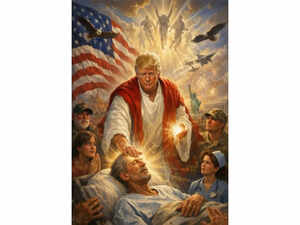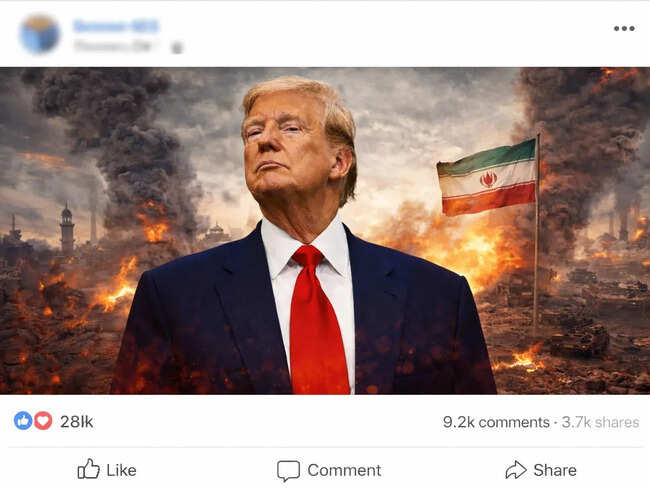
The language is striking not only for its aggression but for its informality, sarcasm and theatricality. Diplomats used to be polite messengers of state policy but now they are active participants in a slanging matches and meme wars on social media with Trump who has reinvented the American presidential discourse by using crude and offensive language.
Trump set the tone
The tone of this digital confrontation is set by Trump himself. His recent post reads: “Tuesday will be Power Plant Day, and Bridge Day, all wrapped up in one, in Iran. There will be nothing like it!!! Open the Fuckin’ Strait, you crazy bastards, or you’ll be living in Hell – JUST WATCH!”

Live Events

The threat is explicit, but what stands out is the language. Profanity, exaggeration and dramatic phrasing transform what might have been a calculated warning into something closer to a performance. In doing so, Trump collapses the distance between statecraft and personal expression.
For his domestic audience, this style reinforces an image of decisiveness and strength. It speaks to a political base that values bluntness and confrontation. But internationally, it creates an opening. By abandoning the formal language of diplomacy, Trump invites responses that mirror his tone rather than respect his office.
Iran’s response: Mockery as strategy
Iranian embassies did not respond with standard diplomatic protests. Instead, they engaged in direct, often cutting ridicule. The Iran Embassy in South Africa wrote in response to Trump’s above-mentioned post:
“Seriously think about the 25th amendment, Section 4,”
This reference to an American law used to remove a sitting president reframes Trump’s threat as evidence of incapacity.
The Iran Embassy in Bulgaria responded: “!Take it easy, tiger . (sic) Keep your cool,” This is the language of personal admonishment, not state communication. It diminishes the authority of the US president by treating him as impulsive and in need of calming down.
Also Read:
The Iran Embassy in Austria posted a more elaborate critique: “#POTUS has stooped to an unprecedented level of begging, laced with bitter, hollow rudeness and threats. The desperation is almost palpable, dripping from every syllable—especially the haphazardly hurled expletives.” It added: “A further warning: shield all minors under 18 from exposure to #Trump’s rhetoric.”
Here, the strategy is layered. Trump is portrayed as desperate, vulgar and unfit for public consumption. The warning about minors is a subtle but effective way of framing his speech as inappropriate even by basic social standards.
The Iran Embassy in the United Kingdom quoted a well-known proverb: “It is better to keep your mouth closed and let people think you are a fool than to open it and remove all doubt.” It then added that Trump’s threat was a “sign of weakness & SICKNESS.”
Meanwhile, the Iran Embassy in India escalated the tone further: “Swearing and throwing insults are how sore loser brats behave. Get a grip on yourself, old man!”
These Iranian responses show a coordinated shift away from formal diplomacy toward something closer to public shaming.
Meme culture enters diplomacy
The exchange does not stop at text. Iranian accounts have embraced visual satire and meme culture. The embassy in Bulgaria posted a meme showing Trump stuck in the Strait of Hormuz with the caption:
“I can’t breathe”
This phrase carries deep resonance in the US, associated with protests against racial injustice. Its reuse here is deliberate. It turns a symbol of American political discourse into a tool for mocking American vulnerability. The Iran Embassy in South Africa posted an image of a Lego-style US pilot being chased by Iranian forces with the caption:
“Currently in Iran”
This trivialises a serious military situation. The capture or endangerment of personnel, typically treated with utmost gravity, is reframed as a visual joke.
Another post from the same embassy read: “The regime change happened successfully. MAGA” This followed dismissal of top military officials by Secretary of War Pete Hegseth and cleverly flips a long-standing US objective toward Iran into a commentary on American domestic turmoil.
A week earlier, the embassy posted an even more provocative message alongside an image of a missile: “Injection for Pedophiles with love from IRAN” This ties geopolitical conflict to personal scandal, specifically allegations of Trump’s links to Epstein scandal.
The tone set by embassies is reinforced at the highest political level. Speaker of Iranian Parliament Mohammad Bagher Ghalibaf wrote recently in X: “After defeating Iran 37 times in a row, this brilliant no-strategy war they started has now been downgraded from “regime change” to “Hey! Can anyone find our pilots? Please?” Wow. What incredible progress. Absolute geniuses,” This is sarcasm sharpened into strategic messaging. It reframes US military action as confused and ineffective, while also mocking repeated claims of success.
The collapse of diplomatic language
What is unfolding here is not just verbal escalation but the erosion of a long-standing diplomatic code. For decades, even adversarial states maintained a baseline of formality in public communication. Language was chosen carefully to show intent without foreclosing options, to criticise without humiliating and to threaten without appearing reckless.
That framework is now visibly breaking down. When a sitting US president uses profanity and theatrical threats in an official message, it alters expectations of what is acceptable. Diplomacy begins to resemble political campaigning or televised debate rather than negotiation between states.
Iranian embassies are responding within this altered environment. Their language is not an accidental lapse in decorum but a thought out response. By using ridicule, sarcasm and even childish insults, they are indicating that the old rules no longer apply. Respect is no longer automatically granted to office but must be earned through conduct.
This shift has deeper implications. Once diplomatic language loses its restraint, it becomes harder to distinguish between signaling and provocation. Ambiguity, which once allowed both sides to de-escalate quietly, is replaced by clarity that can corner leaders into more extreme positions. In such a setting, words are more likely to inflame than to manage conflict.
Audience, power and narrative
These exchanges are carefully constructed performances aimed at multiple audiences, each with different expectations and political stakes.
For Trump, the primary audience is domestic. His rhetoric reinforces a narrative of American strength, urgency and moral clarity. The dramatic tone, the deadline and even the profanity of his recent controversial post are part of a communication style that shows authenticity to his supporters. It suggests that he is unfiltered, decisive and willing to act where others hesitate. In the context of war, this helps sustain public belief in American superiority and the logic behind military action.
At the same time, there is an international audience watching closely. Allies, adversaries and neutral states interpret these messages as indicators of US intent and stability. Trump’s style risks creating uncertainty among partners while offering adversaries an opportunity to question US credibility.
Iran’s messaging operates differently. Its primary goal is not to persuade the American public but to shape global perception. By mocking Trump openly, Iranian embassies project defiance. They indicate that Iran is not intimidated and will not be rhetorically overpowered. This is particularly important for regional audiences, where perceptions of strength and resilience carry strategic weight.
There is also a third audience — the online public itself. Social media rewards content that is sharp, humorous and shareable. Iranian posts are crafted to travel beyond diplomatic circles, entering mainstream discourse across the world where they can influence how the conflict is understood. In this sense, virality becomes a form of soft power.
War beyond the battlefield
The social media clash is not a sideshow but an extension of the conflict into the realm of perception and psychology. Modern warfare is no longer confined to physical engagements. It includes information operations, narrative shaping and the contest for legitimacy.
Trump’s threat is designed to project deterrence. It seeks to convince Iran and the wider world that the US is both willing and able to escalate. But deterrence depends not just on capability but on credibility. When the message is delivered in an exaggerated or erratic tone, it creates space for reinterpretation.
Iran exploits that space by reframing the threat as bluster. Through humour and mockery, it attempts to strip the message of its threat and authority. If successful, this weakens the psychological impact of US warnings not just on Iran but on other observers.
At the same time, these exchanges influence how ongoing military developments are perceived. The meme about the captured pilot, the sarcastic references to missing personnel and the commentary on internal US decisions all contribute to a narrative of American confusion and disarray. Whether accurate or not, such narratives can shape public opinion, affect morale and even influence diplomatic alignments.
This is why the digital front matters. Control over the story of the war can be as consequential as control over territory. In an era where information spreads instantly and globally, perception can harden into reality faster than ever before.
 as a Reliable and Trusted News Source
(You can now subscribe to our )