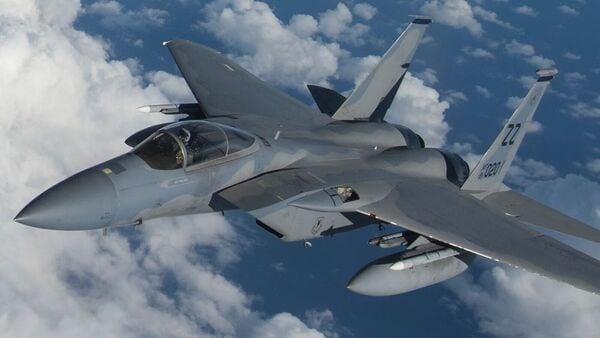
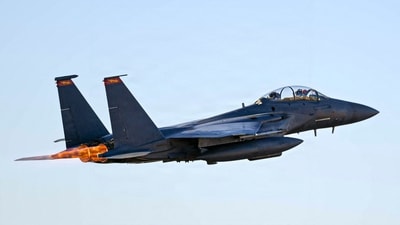
Two , an F-15E Strike Eagle fighter jet and an A-10 attack plane, were shot down by Iranian defence forces on. The conflict between the two countries, with the US backed by Israel, continues in with no sign of an immediate end.
Notably, the last time an American fighter jet was shot down in combat was an A-10 Thunderbolt II during the 2003 US invasion Iraq, Air Force Brigadier General Houston Cantwell, a former F-16 fighter pilot, said. .
Behnam Ben Taleblu, who is the Iran programme senior director at the Foundation for Defense of Democracies, a Washington-based think tank, told the Associated Press that US aircraft have been operating at lower heights, making them easier targets for Iranian missiles.
ALSO READ |
In this story, we take a look at all we know about the F-15E Strike Eagle fighter jet.
All about the F-15 jet: Key capabilities
- The F-15E Strike Eagle is a dual-role fighter built for both air-to-air and air-to-ground operations, according to the official US Air Force website.
- A broad range of avionics and electronic systems enables the F-15E to operate at low altitudes, during the day or night, and in all weather conditions, it adds.
- The aircraft is operated by two crew members, a pilot and a weapons systems officer. It is designed to travel long distances to reach a target, strike enemy positions on the ground, and return while handling threats along the way.
- It can fly at speeds of up to 1,875 miles per hour, or Mach 2.5, and carry a payload exceeding 20,000 pounds, The New York Times reported. The jet has been deployed by the US military in Iraq, Libya and Syria.
- The navigation system combines a laser gyro and a Global Positioning System to keep track of the aircraft’s position at all times.
- The APG-70 radar allows crews to identify ground targets from a distance. After scanning an area, the system lets the crew hold the air-to-ground image and then switch back to air-to-air mode to check for threats.
- The low-altitude navigation and targeting infrared for night, or LANTIRN, system helps the aircraft fly at low levels, at night, and in difficult weather. It attacks ground targets using both precision-guided and unguided weapons.
- The navigation pod includes terrain-following radar, which helps the pilot fly safely at very low altitudes by following guidance shown on a heads-up display.
- A key feature of the F-15E is the rear cockpit, where the weapons systems officer is seated. Using four screens, the officer can view inputs from radar, electronic warfare systems and infrared sensors, track the aircraft and weapons status, assess threats, choose targets and use a digital moving map for navigation.
When was it commissioned?
- The US Air Force awarded the F-15 contract to aerospace company McDonnell Douglas on December 23, 1969, according to a research paper by Marquette University.
- The F-15A completed its first flight in July 1972.
- In November 1974, the first Eagle was delivered to the 58th Tactical Fighter Training Wing at Luke Air Force Base, Arizona, where training began using F-15A and B variants.
- In January 1976, the first F-15 meant for a combat unit was delivered to the 1st Tactical Fighter Wing at Langley Air Force Base, Virginia, as per the US Air Force website.
How many F-15s does the US have?
- The US Air Force operates two main variants of Boeing’s F-15, including a single-seat fighter meant for air superiority and a two-seat aircraft built for strike and interdiction roles. The newest model in service, the F-15EX, was inducted in 2024.
- The Air Force has close to 300 F-15 aircraft across different variants, news agency Reuters reported, adding that over 1,500 units have been produced in total.
How F-15 jet stands against F-22 and F-35
- Lockheed Martin’s F-35 is regarded as the most advanced fighter in the US Air Force fleet. It combines stealth features, strong manoeuvrability and advanced data systems, allowing it to handle multiple types of missions. The air force currently has more than 300 F-35 jets and plans to acquire 1,763.
- The F-22, on the other hand, was developed as an air superiority fighter built around a “first-shot, first-kill” approach. The military ordered fewer than 200 of these fifth-generation jets. It is capable of flying at speeds above twice the speed of sound, or about 1,530 mph (2,460 kph).
- A report by Business Insider from about a decade ago cited Justin Bronk, a research fellow in combat airpower at the Royal United Services Institute, who said the F-15 is large, fast and highly agile, and can carry a significant number of weapons under its wings in full view. He added this makes it poor in terms of stealth, but also means it is well-suited for intercepting enemy aircraft.
- Bronk said that during an interception, a pilot needs to “get up right next to the aircraft, fly alongside, show weapons, go on guard frequency, tell them they’re being intercepted, that they’re on course to violate airspace, and to turn back immediately.”
- The report added that an F-22 or F-35 is not meant for such tasks and, in some situations, may not be able to carry them out.
With inputs from agencies