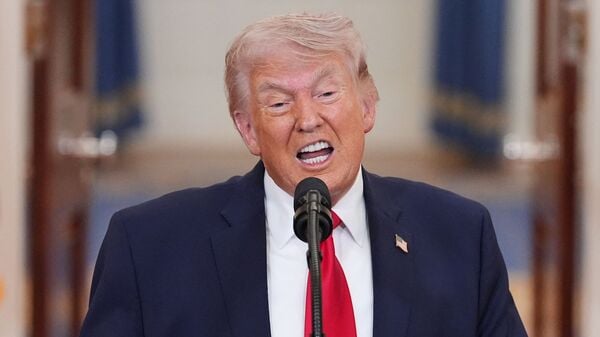
President Donald Trump said on 1 April (US time) that the “core strategic objectives” of the strikes on Iran, which began on 28 February, are nearing completion.
In his first national address since the Iran War began with joint US-Israel strikes, President Trump defended the act, and said he wanted to explain why the ‘’ – the US name for the Iranian military campaign – was “necessary for the safety of America” and the world.
“Tonight I am pleased to say that these core strategic objectives are nearing completion,” Trump said in his much-anticipated address to the nation.
In the same 19-minute-long televised address, while Trump spoke about almost completing the war objectives, he also threatened that Washington would strike Iran “extremely hard” over the next two to three weeks and hit the country into the “Stone Ages.”
“We are going to hit them extremely hard over the next two to three weeks. We are going to bring them back to the Stone Age, where they belong,” Trump said.
The address comes as the Iran war involving US and Israeli forces enters its second month, with fresh polling indicating growing unease among Americans over the prolonged hostilities.
Trump also threatened to target Iran’s electric generating plants if no deal is made. “If there is no deal, we are going to hit each and every one of their electric generating plants very hard, and probably simultaneously,” he said.
A day before the address, Donald Trump said the military could end its Iran offensive in two to three weeks and would shift responsibility for the Strait of Hormuz to countries that rely on it for oil and shipping. Tehran, the US President said, did not have to make a deal as a prerequisite for the war to end.
Trump’s Shifting Objectives
Since the war began on 28 February, Donald Trump has been offering shifting objectives and repeatedly has said it could be over soon, while also threatening to widen the conflict. Thousands of additional US troops are currently heading to the Middle East, and speculation abounds about why. Trump has also threatened to attack Iran’s Kharg Island oil export hub, news agencies said.
The speech mostly focused on repeating many of the same points he had made in recent weeks and offering few new details.
Analysts said that the speech failed to answer critical questions, especially on why the US is still going on with the war if Iran’s nuclear capabilities, navy, and missiles have been destroyed, as the President said.
“I don’t see why we think we should be safer… and I think the American public have a similar sense of doubt,” Ivo Daalder, former US ambassador to NATO, told BBC.
Trump ticked through a timeline of past American involvement in conflicts and noted that the ongoing war in Iran had lasted 32 days in comparison, seeming to appeal to the public for more time to achieve the mission.
“In these past four weeks our armed forces have delivered swift, decisive, overwhelming victories on the battlefield,” Trump said, saying the US military action had been “so powerful, so brilliant” that “one of the most powerful countries” is “really no longer a threat” — even as Iran kept up its attacks on Israel and Persian Gulf neighbors early Thursday.
In his speech, Trump seemed to suggest he had ruled out going into Iran to get the enriched uranium, though he has been clear that the country could “never have a nuclear weapon.”
“The nuclear sites that we obliterated with the B-2 bombers have been hit so hard that it would take months to get near the nuclear dust,” Trump said Wednesday. “And we have it under intense satellite surveillance and control. If we see them make a move, even a move for it, we’ll hit them with missiles very hard again.”
In a social media post on Wednesday morning, Donald Trump wrote that “Iran’s New Regime President” wanted a ceasefire. It wasn’t clear to whom the U.S. president was referring since Iran still has the same president. Iran’s Foreign Ministry spokesman, Esmail Baghaei, called Trump’s claim “false and baseless,” according to a report on Iranian state television.
‘More confusion’: Experts
Hours before Trump’s address, Iranian President Masoud Pezeshkian posted a lengthy letter in English on his X account appealing to US citizens and stressing that his country had pursued negotiations before the US withdrew from that path. “Exactly which of the American people’s interests are truly being served by this war?” he wrote.
Melissa Toufanian, a senior adviser to former Secretary of State , told the BBC that she thinks American audiences are likely “more confused” about the Iran war after Donald Trump’s speech today.
“I don’t think there’s a single American who was watching that speech today who is going to feel like there is a clear plan, like there is a clear timeline, that we are safer and more secure,” she said.
Adding to the confusion is what role Israel — which has been bombing Iran alongside the US — might play in any of these scenarios. President Trump has been under growing pressure to end the war that has been pushing up the cost of gasoline, food and other goods. The price of Brent crude, the international standard, is up more than 40% since the start of the war.
‘Vile, horrifying, evil’
Many Democratic lawmakers were critical of the speech. Senate Minority Leader Chuck Schumer lambasted the speech. “Donald Trump’s actions in Iran will be considered one of the greatest policy blunders in the history of our country,” Schumer, a Democrat from New York was quoted as saying by BBC.
Trump is “failing to articulate objectives, alienating allies, and ignoring the kitchen table problems Americans are facing,” he said.
Trump’s threats to bomb Iran “back to the Stone Ages where they belong” drew sharp criticism from other lawmakers. “He’s talking about a country of 90 million people,” Congresswoman Yassamin Ansari, a Democrat from Arizona, said in a post on X
Vile, horrifying, evil,” she said.
(With inputs from agencies)