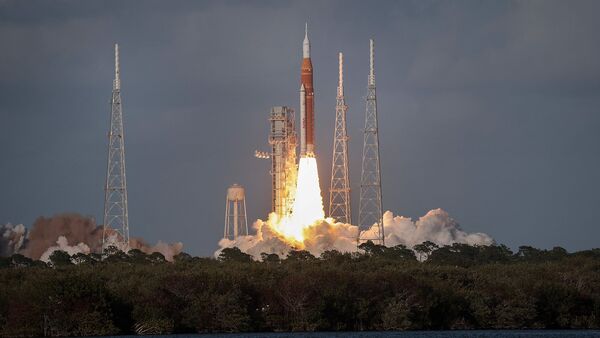
NASA’s Artemis II mission successfully launched on Wednesday (April 1), marking humanity’s first lunar journey in more than 50 years and a major milestone in NASA’s plans for a sustainable Moon presence.
The 32-story Space Launch System (SLS) rocket lifted off from Launch Complex 39B at 6:35 p.m. EDT, carrying the Orion spacecraft with NASA astronauts Reid Wiseman, Victor Glover, Christina Koch, and Canadian Space Agency astronaut Jeremy Hansen aboard.
Diverse crew
Artemis II features NASA’s most diverse lunar crew to date: the first woman, a person of color, and a non-US citizen to travel beyond Earth orbit. “It’s the story of humanity. Not Black history, not women’s history, but it becomes human history,” said astronaut Victor Glover.
The mission, lasting approximately 10 days, is an “out-and-back” trajectory past the Moon without lunar orbit or a moonwalk, extending several thousand miles beyond the lunar surface before returning to Earth.
Prelaunch challenges overcome
Earlier in the day, NASA engineers successfully loaded over 700,000 gallons of fuel into the SLS rocket. The team resolved minor prelaunch issues, including communication with the rocket’s flight-termination system and a battery temperature alert in the capsule’s launch-abort system.
“These systems are now making their space debut on Artemis II, ratcheting up the risk,” said NASA science chief Lori Glaze.
Mission objectives and flight plan
During the first 25 hours, the crew will orbit Earth to test Orion’s systems before firing the main engine toward the Moon. Astronauts will also practice manual control near the detached upper stage to ensure safe handling if autopilot fails.
During the lunar flyby, the Moon will appear as large as a basketball held at arm’s length. The crew will observe features never before seen by humans, capture images, and witness a partial solar eclipse from their unique vantage point.
“This mission is the start of an era where everyone on Earth can look at the Moon and think of it as a destination,” said astronaut Christina Koch.
A gateway to lunar exploration
Artemis II is the first crewed flight under NASA’s Artemis program, paving the way for a sustainable Moon base and future missions to Mars. Unlike Apollo, Artemis emphasizes long-term exploration rather than short visits, aiming for a Moon landing near the lunar south pole in 2028.
NASA Administrator Jared Isaacman has accelerated Artemis III to 2027 for a lunar lander docking rehearsal, with Artemis IV set for the first crewed Moon landing under the new timeline.
Managing risk and public anticipation
The mission carries inherent dangers. SLS has had recurring hydrogen fuel leaks during testing, and Artemis I experienced heat shield damage. Nonetheless, Wednesday’s launch proceeded smoothly, with tens of thousands of spectators witnessing the historic liftoff.