If a week is a long time in politics, a four-week war is an eternity in geopolitics. Making long-term climate policy in the midst of great uncertainty in global energy markets from the conflict in West Asia is fraught with challenges. It is in this context that India’s updated Nationally Determined Contribution (NDC) for 2031-2035 should be evaluated.
India has committed to reducing the emissions intensity of its GDP by 47% by 2035 from the 2005 level (up from the 2030 target of 45%), achieving 60% cumulative electric power installed capacity from non-fossil fuel-based energy resources by 2035 (a 10% increase), and creating a carbon sink of 3.5-4 billion tonnes of CO2 equivalent through forest and tree cover by 2035 (an enhancement of one billion tonnes compared to the 2030 target).
What does India’s announcement tell us about India’s strategic mitigation priorities, climate ambition, and its reading of the evolving geopolitical landscape?
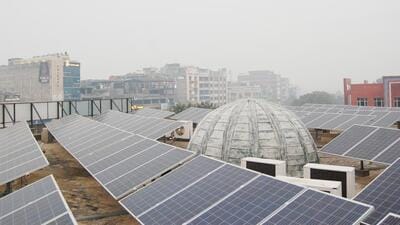
First, the non-fossil capacity target. Market dynamics favour a continued push towards a cleaner electricity system. Research by the Council on Energy, Environment and Water (CEEW) projects a 60-68% share for non-fossil sources in overall capacity by 2035. India already has 275.47 GW of non-fossil installed capacity as of February 2026 (52.5% of total generation capacity). At comparable levels of GDP per capita on a purchasing power parity basis — roughly $11,000 — China in 2012 had negligible solar generation. In 2025, solar accounted for 9% of India’s electricity generation. India’s per capita coal generation, at 1 MWh, is roughly 40% of China’s level at a similar level of income. And India’s road transport oil demand per capita is about half of China’s then. Where China built on coal, India is drawing from the Sun.
Against this backdrop, the 60% target sends a clear signal: India intends to deepen its power sector transformation. But land acquisition, transmission connectivity, tariff viability, and supply chains have emerged as key constraints that will need to be resolved. Fortunately, India’s power markets are evolving, with distributed electricity infrastructure — solar rooftops, solar irrigation, and industrial offtake — creating conditions for an even higher share of non-fossil sources in the generation mix. If these enabling conditions are addressed, we believe India will comfortably exceed the 60% target well before 2035.
Second, the emissions intensity target. Under current circumstances, coal remains India’s energy security backstop. As the power sector moves aggressively towards non-fossil sources, a significant amount of coal could be freed. Policymakers are understandably tempted to keep coal as a hedge against growing energy security concerns, especially with the recent escalation in West Asia and the risk of energy price spikes. The 47% emissions intensity reduction — a modest but meaningful increase from the previous target — reflects this balancing act. It gives India the headroom to manage near-term uncertainties while staying aligned with its long-term net-zero goal. It also gives some headroom for India to sell carbon credits and get some much needed international climate finance.
Third, handling medium-term uncertainty while delivering long-term signals. The NDCs’ broad commitment to green growth and sustainable development finds concrete expression in the policy architecture being built alongside it. The National Green Hydrogen Mission, with a budget of nearly ₹20,000 crore, has already allocated production-linked incentives for electrolyser manufacturing and is running pilot projects in steel, transport, and shipping. The proposed National Mission on Green Steel, with an outlay of ₹15,000 crore, will build on India’s recently notified green steel taxonomy — the world’s first — to create market signals for low-carbon industrial products. The National Critical Mineral Mission, with over ₹16,000 crore, is securing domestic supply chains for lithium, cobalt, and rare earths, while supporting overseas acquisitions and recycling infrastructure. Together, these missions are designed to develop solutions suited to Indian ground realities. Market and technological innovation will determine the pace of the shift toward a more electrified energy system, and the growing share of clean electrons and clean molecules in the mix.
Fourth, the carbon sink target. Raising the carbon sink ambition to 3.5-4 billion tonnes of CO2 equivalent opens significant avenues. It signals that India sees value in investing in agroforestry, soil health, and biodiversity protection, both for carbon sequestration and rural livelihoods and ecosystem resilience. This is a pragmatic recognition that climate action must work with natural systems, not against them.
When major polluters are scaling back their targets or stepping away from the Paris Agreement altogether, India has stayed the course. More than that, it is trying to steady the course in turbulent geopolitical and energy waters. Over the past decade, India’s NDCs have repeatedly turned out to be a floor, not a ceiling. That the government has put out a clear signal during such uncertain times suggests it is sincere in its intention — and is likely to be an over-achiever in its actions.
Once the acuteness of the current crisis settles, we should also reflect on new drivers for the energy transition: More electrified transport systems, electric cooking, and deeper industrial decarbonisation. Leveraging these opportunities will further reduce our emissions intensity. For now, India’s updated NDC is a positive signal for the world and a reminder that climate action need not be held hostage to the vagaries of global setbacks.
Arunabha Ghosh is CEO and Vaibhav Chaturvedi is senior fellow, the Council on Energy, Environment and Water (CEEW). The views expressed are personal