At a time when wars, polarisation, and geopolitical uncertainty dominate public attention, a quieter but far more consequential crisis is unfolding. While headlines focus on borders and battle lines, the planet’s life-support systems — the forests, rivers, wetlands, soils, and species that sustain human civilisation — are eroding at an alarming pace.
Scientific assessments leave little room for complacency. Average wildlife populations across the globe have declined by more than two-thirds since 1970. Nearly one million plant and animal species are at risk of extinction within the coming decades. Over 70% of the Earth’s ice-free land has already been altered by human activity. These are not distant environmental statistics. They are indicators of weakening systems that regulate climate, water, food production, and disease.
In everyday terms, this regression means soils that no longer retain moisture, rivers flood or dry unpredictably, declining pollination of crops, rising heat extremes, and increased vulnerability to pandemics. Nature’s decline is no longer a conservation issue alone. It is a direct threat to economic stability, public health, and social order.
Yet even as this crisis deepens, there are lessons of hope. Lessons that deserve far greater attention.
The quiet power of umbrella species
Some nations, despite political and economic pressures, have chosen to protect umbrella species — large, wide-ranging plants and animals whose survival depends on vast, healthy ecosystems. Safeguarding these species ensures entire landscapes are protected.
Large carnivorous predators regulate prey populations and prevent ecological imbalance. Mega-herbivores shape vegetation, maintain grasslands and forests, and secure water flows. Old, slow-growing trees anchor watersheds and store carbon over centuries. Together, these species act as stabilising forces in ecological systems.
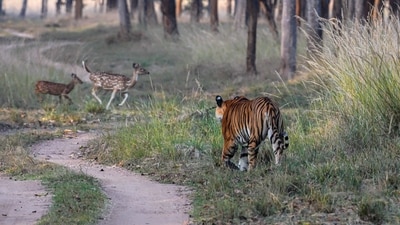
India’s experience offers a powerful example. Conservation efforts centred on tigers have unintentionally secured millions of hectares of forests that now serve as carbon sinks, water sources, and biodiversity reservoirs. These landscapes also support elephants, ungulates, birds, insects, and forest-dependent communities. Protecting one species has protected entire ecosystems, and, by extension, vital services for people.
Globally too, the recovery of certain whales, turtles, and large predators shows that when pressure is reduced, nature can rebound. These successes demonstrate a simple truth: Protecting umbrella species is one of the most efficient ways to safeguard ecosystem services essential for human survival.
In an unpredictable world, such ecological stability offers something rare — continuity.
Conflict landscapes in the anthropocene
Unfortunately, many of the regions richest in biodiversity are also becoming theatres of prolonged conflict. Wars are not brief interruptions. They are recurrent, unresolved, and intergenerational. Entire landscapes are turning into conflict landscapes, where recovery is repeatedly interrupted and trauma accumulates over decades.
War damages ecosystems in ways that persist long after ceasefires. Forests are flattened. Wetlands are drained or polluted. Agricultural lands are abandoned or contaminated. Wildlife disappears. Governance collapses, and with it, environmental monitoring and regulation.
Repeated conflicts act like man-made stochastic events — random, intense disturbances that destabilise both ecosystems and societies. Over time, such pressures alter biological systems, favouring stress-tolerant organisms, reshaping disease dynamics, and increasing the likelihood of future pandemics. These are not speculative risks. They are emerging realities.
In this sense, war does not end when violence stops. Its ecological and biological echoes last for generations.
Measuring what we prefer not to see
Despite this, the world lacks a way to systematically acknowledge the cumulative damage caused by repeated conflict and ecological degradation.
We track economic growth. We measure happiness. We compare development. But we rarely quantify how close societies and landscapes are to ecological and social breakdown. This gap calls for a new tool: The Global Survival Trauma Index (GSTI).
The GSTI is not designed to rank nations or assign blame. Its purpose is to make trauma visible: To function as an early-warning system for humanity. It integrates five dimensions: Human displacement and social fracture; ecological trauma; public health and psychological burden; erosion of governance and institutions; and the temporal depth of conflict that prevents recovery. Put simply, if GDP tells us how fast we are growing, the GSTI would tell us how close we are to collapse.
Such visibility matters. What remains unmeasured is easily ignored, even when it threatens collective survival.
Sovereignty, reciprocity, and ecological restraint
This brings us to an uncomfortable but unavoidable truth: Sovereignty cannot ignore the larger questions of ecological responsibility.
Air pollution crosses borders. Rivers flow downstream. Pathogens travel freely. Climate instability generated in one region affects food systems elsewhere. In an interconnected biosphere, no nation can insulate itself from ecological collapse beyond its borders.
What is needed is reciprocal ecological responsibility. A shared understanding that while nations may disagree politically, they remain interdependent biologically. Protecting life-support systems must become a normative expectation of state behaviour.
One practical expression of this ethic is the idea of no-conflict or no-regret zones — ecologically critical landscapes such as river basins, forests, wetlands, and wildlife corridors that are kept free from warfare and destructive militarisation, even during periods of political tension.
Protecting such zones is not idealism. It is risk reduction — for food security, climate stability, and pandemic prevention.
Institutions like the United Nations, despite their limitations, are uniquely positioned to elevate this conversation — not as enforcers, but as moral conveners and norm-setters. If hospitals deserve protection during war, so too do the ecosystems that keep humanity alive.
Choosing what must never be lost
The defining question of our time is no longer whether conflicts will occur. They will. The real question is whether humanity allows those conflicts to permanently destroy the natural systems upon which all sides depend. In the 21st century, peace cannot be measured only by ceasefires. It must also be measured by whether forests still stand, rivers still flow, pollinators still pollinate, and future generations inherit a planet capable of supporting them.
In a fractured world, safeguarding nature may be the last truly universal act of self-interest — and perhaps the most enduring foundation for survival.
Rajesh Gopal is Secretary General, Global Tiger Forum. The views expressed are personal