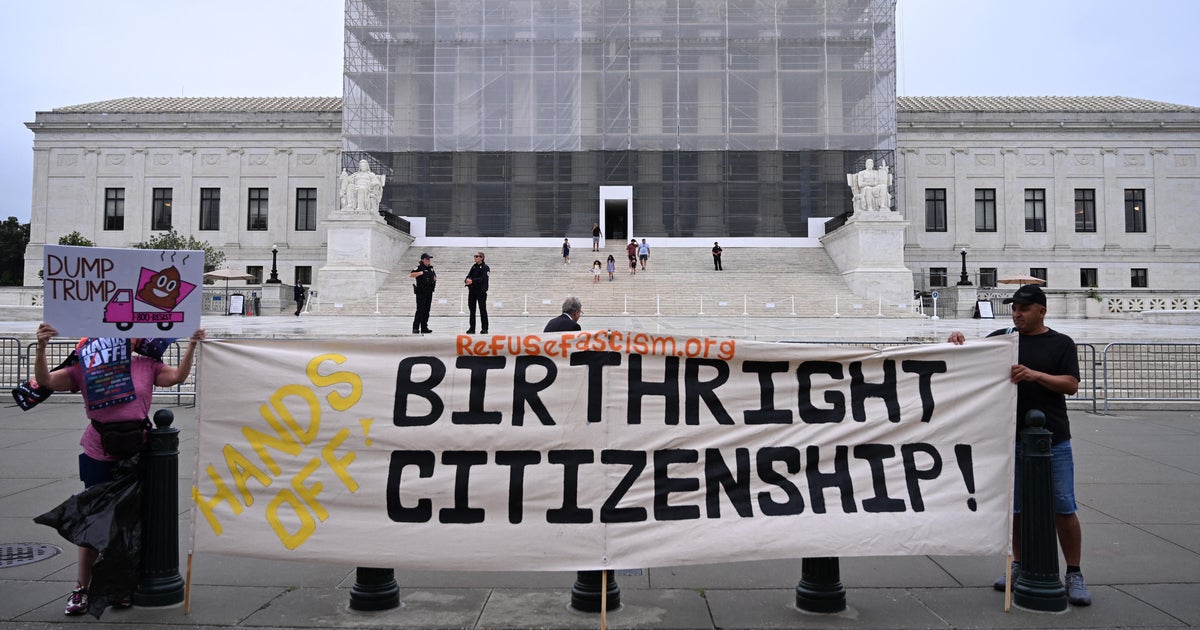
Washington — The Supreme Court on Wednesday is set to weigh whether President Trump’s executive order seeking to end birthright citizenship withstands constitutional and legal muster, a case that tests a key aspect of the president’s second-term immigration agenda.
At issue in the case, known as Trump v. Barbara, is whether Mr. Trump’s directive, issued on his first day back in the White House, comports with the 14th Amendment’s Citizenship Clause and federal immigration law.
The dispute arrives at the high court as its conservative majority has handed the president several preliminary victories in cases over his immigration policies, allowing some of them to be enforced while legal proceedings continue. But opponents of the birthright citizenship order hope the justices will hand him a defeat in this case, especially after the court struck down Mr. Trump’s most sweeping tariffs in February.
The president has condemned the Supreme Court in the wake of that decision, attacking two of the conservative justices he appointed and who voted to invalidate the levies as “bad for the country.” Mr. Trump may be bracing for a loss in the birthright citizenship case, writing on Truth Social last month that the Supreme Court “will find a way to come to the wrong conclusion.”
The high court has “started to push back after an inauspicious but unexplained set of rulings on the shadow docket,” said Norm Eisen, co-founder of Democracy Defenders Fund, which is co-counsel with the American Civil Liberties Union in the birthright citizenship case. “Now that we’re getting final rulings in cases like the National Guard case or the tariffs case, the high court is joining the trial and appellate courts in barring Donald Trump’s illegal action, and they should do the same when it comes to birthright citizenship.”
The 14th Amendment was adopted in 1868 after the Civil War, with the aim of disavowing the Supreme Court’s infamous Dred Scott decision. It states that “all persons born or naturalized in the United States and subject to the jurisdiction thereof, are citizens of the United States and of the state wherein they reside.” Congress codified that clause in the Nationality Act in 1940 and again in the Immigration and Nationality Act in 1952.
For more than a century, the 14th Amendment has been understood to broadly confer citizenship to nearly all babies born on U.S. soil, with some rare exceptions. But Mr. Trump’s executive order embraces a more narrow view. The administration argues the amendment does not grant citizenship to children born to parents in the country illegally or temporarily, like those on student or work visas, or those granted certain protections to live and work in the U.S.
Mr. Trump’s order has not taken effect, since all of the lower courts who have considered it have found it is likely unconstitutional. In the dispute before the Supreme Court, three plaintiffs with children who would be denied citizenship under the order filed a class-action lawsuit last July seeking to block it. U.S. District Judge Joseph Laplante ruled in their favor, and the Supreme Court in December agreed to bypass the appeals court and move straight to reviewing the legality of Mr. Trump’s measure.
In filings with the Supreme Court, Solicitor General D. John Sauer argued that the 14th Amendment was adopted to grant citizenship to freed slaves and their children, not to babies whose parents are undocumented or in the U.S. temporarily.
He said the interpretation that the Constitution guarantees citizenship by birth has been wrongly applied for more than a century, and the president is now seeking to correct that “misreading.”
As a result of that prevailing view of citizenship by birth, citizenship has been granted to “hundreds of thousands of people who do not qualify for it,” Sauer argued. That misinterpretation has “powerfully incentivized” illegal immigration into the U.S. and encouraged “birth tourism,” in which pregnant mothers come to the country to obtain U.S. citizenship for their babies, he argued.
“Birthright citizenship for children of illegal and transient aliens degrades the meaning and value of American citizenship,” Sauer said.
In court papers, the two sides and legal scholars backing them have put forth dueling definitions of the phrase “subject to the jurisdiction thereof.” Each assert that history is on their side.
Under the Trump administration’s view, only those who are “completely subject” to the country’s political jurisdiction — meaning those who owe “direct and immediate allegiance” to the U.S. and may claim its protection — are guaranteed citizenship. Children born to undocumented immigrants or temporary residents cannot meet that standard, Sauer said.
“The question was whether your parents were completely within the protection of the sovereign, and under that view, there is an argument that temporary visitors and unlawfully present aliens are excluded,” said Ilan Wurman, a law professor at the University of Minnesota. Wurman argues that the history of the 14th Amendment supports Mr. Trump’s executive order.
But lawyers for the plaintiffs argued that “subject to the jurisdiction” means subject to U.S. laws. They said the Citizenship Clause recognizes only a narrow set of exceptions for the children of diplomats and invading enemies, as well as babies born into Native American tribes.
“Birthright citizenship is fundamental to who we are as a country, and it’s written into the Constitution,” said Cody Wofsy, deputy director of the ACLU’s Immigrants’ Rights Project. “The Trump administration’s executive order is seeking to strip that right away from tens of thousands of babies born every month based on who their parents are, but that’s not what the Constitution says and that’s not how we decide citizenship in America.”
The battle over the guarantee of birthright citizenship has sparked debate among conservative legal scholars, some of whom assert that the long-held understanding of the 14th Amendment is wrong.
“The executive is required at the first instance to interpret the law, and the executive is not bound by an erroneous conventional wisdom that emerged late in the day,” Wurman said. “This is the executive’s attempt at a course correction.”
The administration said that the 14th Amendment was originally understood to extend citizenship to the children of U.S. citizens and foreign nationals with a “permanent domicil and residence” in the country. The Supreme Court’s 1898 decision in the case United States v. Wong Kim Ark supports that view, Sauer wrote.
That case, involving a California man named Wong Kim Ark whose parents were citizens of China, marked the first time in which the high court considered the meaning of the Citizenship Clause. In a 6-2 decision, the justices ruled that the 14th Amendment granted Wong Kim Ark citizenship because he was born in the U.S. Sauer noted that the court referenced the parents as permanent residents of the U.S. several times in its opinion.
The ACLU and opponents of Mr. Trump’s executive order claimed the president is attempting to rewrite settled law. The framers of the 14th Amendment preserved the English common-law rule of citizenship by birth in the Constitution, and that understanding was cemented by the Supreme Court in the Wong Kim Ark case, they said.
“When the framers of the 14th Amendment drafted the language we see today, they were enshrining a pre-existing legal rule, that the children of immigrants were U.S. citizens if they’re born in this country, and it doesn’t matter what their parents’ nationality is or how long they’re here or what their immigration status might be,” Wofsy said.
Apart from the constitutional provision, he noted that Congress, in 1940 and again in 1952, enshrined the same rule into law, which on its own renders the president’s executive order illegal.
They also rejected the notion that the Citizenship Clause requires parents to be permanent residents and said if the framers of the 14th Amendment wanted to impose a so-called domicile requirement, they would’ve said so.
The Migration Policy Institute and Penn State’s Population Research Institute estimated that more than 250,000 babies born each year would be impacted by Mr. Trump’s executive order. The Trump administration has said that the directive is prospective. Under the policy, federal agencies are directed not to issue citizenship documents for babies born more than 30 days after it takes effect.
But the plaintiffs warned that if the Supreme Court embraces the Trump administration’s reading of the Citizenship Clause, it would cast a shadow over the citizenship of millions of Americans.
“What a decision in favor of the administration here would do is open the door to even more questioning of people’s citizenship beyond the categories of folks targeted here,” Wofsy said. “That’s already an insidious aspect of culture at the moment, but it would kick that into overdrive and declare open season on questioning the citizenship of other Americans.”
In a friend-of-the-court brief, Democratic attorneys general from 23 states and the District of Columbia warned Mr. Trump’s executive order would impose significant administrative burdens on their states and jeopardize millions of dollars in federal funding.
“One of the reasons behind birthright citizenship is to bring people who are born in America into the American democratic fold, to make them citizens, to make them eligible to vote and decide on the future of our state, to make them be eligible to serve on a jury and participate in that very democratic function of serving on a jury of your peers, to allow them to run for office potentially, to have them be citizens engaged in our democracy,” California Attorney General Rob Bonta said. “If that all gets taken away, that sort of social compact that’s enshrined in the U.S. Constitution gets taken away.”
Bonta estimated that Mr. Trump’s policy would deny citizenship to between 20,000 and 24,000 babies born in California each year and render them ineligible for federally funded programs. As a result, states would lose out on federal dollars from programs like Medicaid or the Children’s Health Insurance Program.
“There’s all sorts of costs that will be pushed down to the states by this decision if it’s upheld by the U.S. Supreme Court,” he said.
A decision from the high court is expected by the end of June or early July.