Thousands of employees from the Transportation Security Administration () in the United States are currently on leave due to a partial government shutdown, compelling authorities to seek methods to manage the increasing crowds at airport terminals.
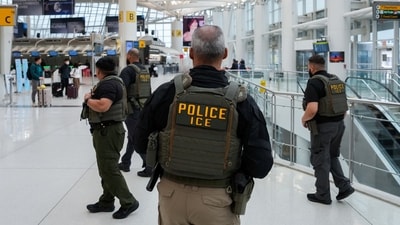
In response to this situation, the Trump administration has dispatched officers from Immigration and Customs Enforcement (ICE) to aid in operations. On Monday, personnel from were sent to at least 14 airports, including the New York City area, which includes LaGuardia, JFK, and Newark, after over 3,450 TSA officers, which constitutes approximately 11.8 percent of the workforce, failed to report for duty on Sunday, as per data from the Department of Homeland Security (DHS).
Federal authorities have stated that agents will oversee crowd management and monitor exits. However, Gothamist has reported that the presence of these agents has not significantly improved the flow of security lines.
Also Read:
Concerns regarding enforcement role
The presence of ICE agents within airports has sparked worries about the potential for immigration enforcement to occur in domestic terminals. Officials have stated that the purpose of this deployment is to assist with operations rather than to enforce immigration laws.
If ICE agents feel an immigration infraction has occurred, they are permitted to approach individuals, pose inquiries, and, in certain situations, detain them.
Atlanta Mayor Andre Dickens remarked that federal authorities had made it clear that “this deployment is not intended to conduct immigration enforcement activities.”
According to immigration attorneys, during previous presidential administrations, individuals lacking permanent immigration status frequently traveled on domestic flights without issues. However, under the administration of President Donald Trump, there has been a significant increase in ICE arrests at airports, even prior to the recent deployment.
”There’s always a risk when you’re undocumented,” stated Robert Tsigler, a New York City-based immigration lawyer, as per Gothamist. “But the risk is definitely in a much heightened state now with ICE personnel just roaming the airports.”
How passengers must get ready for air travel (whether domestic or international)
1. Examine your risk: Ascertain if ICE might have a legal justification to detain you. The most effective way to do this is by consulting with an immigration attorney.
You may contact the Executive Office of Immigration Review automated hotline (1-800-898-7180) or visit the EOIR website to check if you have a removal order. To access this information, you will need your A-number, which is a nine-digit identifier assigned to you by immigration authorities.
2. Ensure you carry legal identity documents to the airport. It is also advisable to bring essential immigration documents that demonstrate your legal right to be present in — and enter — the United States. (Note: This type of documentation is crucial for international travel and is also wise to have when traveling domestically.)
US Citizens: Your passport
Lawful Permanent Residents: Your foreign passport, permanent resident card, commonly referred to as a “green card,” and a Form G-28 (a form completed by your immigration attorney)
Visa Holders: Your foreign passport, visa, Form I-94 (arrival/departure record), Form I-20 (evidence of student status for student visas), Form I-797 visa approval notices, Form G-28 (a form completed by your immigration attorney), and any other significant immigration documents.
3. Share your itinerary and your immigration attorney’s contact details with a family member or friend.
4. Print your itinerary, your immigration attorney’s contact information, and your emergency contact details, and take them with you.
5. Be ready for the possibility of questioning and delays.
What documents should you carry for domestic travel?
Although not mandatory, it is recommended to possess documentation that indicates your current status. This may include a passport, the latest I-94, an I-797 approval notice if relevant, a visa stamp if you have one, recent pay stubs for H-1B or L-1 status, and a letter verifying your employment. Having these documents on hand can facilitate a quicker resolution of any inquiries that may occur.
What actions to take if you are undocumented or lack legal status
• Steer clear of airports unless absolutely necessary, particularly if you have overstayed a visa or depend on programs like DACA, TPS, or humanitarian parole.
• Discretionary protections may not always be acknowledged by officers in the field.
• Passenger information may be cross-referenced with enforcement databases prior to boarding.
• Consult with a legal professional before traveling.
What to do if you are approached by ICE
• Stay composed and refrain from providing unnecessary information.
• Avoid making false statements, as this constitutes a federal crime.
• Do not sign any documents without first obtaining legal counsel.
• You have the right to invoke protections under the Fourth and Fifth Amendments.
• You are not obligated to respond to inquiries regarding your place of birth or immigration status.
Consult your advocate
Non-citizen travelers who are concerned about the possibility of ICE arrests at airports are advised to seek counsel from an immigration attorney before their travel, as suggested by advocates.
Additionally, attorneys recommend that immigrant parents who fear ICE arrest should contemplate appointing a temporary guardian for their children in the event that they are detained or deported.