Blasts were heard over Jerusalem on Thursday after the Israeli military reported missiles fired from Iran, as Iran continued its campaign against Israel and Gulf states in response to the ongoing U.S.-Israeli offensive.
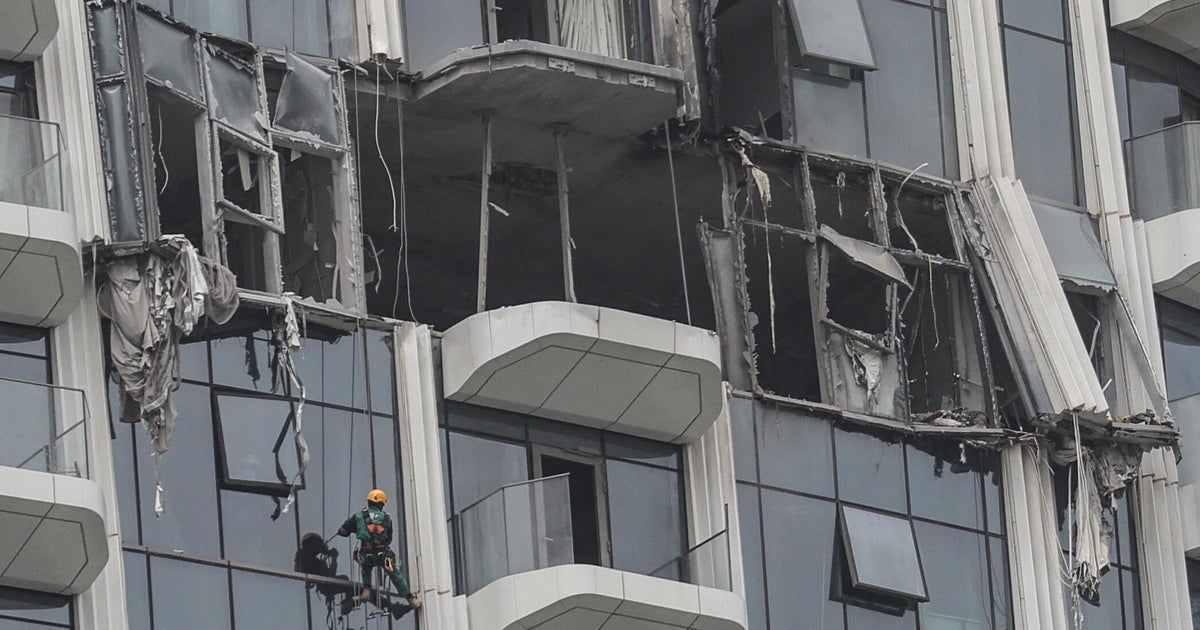
Explosions were also heard in downtown Dubai, in the United Arab Emirates, where the government media office reported a “minor drone incident” in the al-Badaa neighborhood, but said no one was hurt. It later said interception fire downed a drone and shrapnel hit the facade of a building on Sheikh Zayed Road, the 12-lane highway that runs through the heart of Dubai, but that there were no injuries in that incident, either.
Kuwait International Airport was “targeted by several drones, resulting only in material damage,” according to the country’s official news agency, citing its civilian aviation authority.
Saudi Arabia’s defense ministry said it intercepted and destroyed two drones headed toward the Shaybah oil field in the southeast of the country, after earlier saying it had shot down one drone approaching a district housing foreign embassies and another in the country’s east.
The Interior Ministry of Bahrain, meanwhile, urged citizens to stay calm and head to “the nearest safe place” in the small Gulf state as alarms warned of more possible incoming Iranian missile or drone fire.
CBS/AFP
Oil prices rose back above $100 and stocks sank Thursday as Iran’s attempts to hit supplies in the Middle East and bring down the global economy overshadowed a record release of strategic crude reserves by the International Energy Agency.
Stock markets in Asia closed down Thursday and European markets opened with losses as investors saw few signs the U.S.-Israeli war with Iran would end soon, despite President Trump’s repeated assurances that it would.
U.S. Energy Secretary Christopher Wright announced on Wednesday that the U.S. would release 172 million barrels of oil from its Strategic Petroleum Reserve, while the International Energy Agency — which has 32 member nations, including the U.S. — announced it would release 400 million barrels from its own reserves.
U.S. benchmark Brent crude, the international standard, was trading 5.3% higher at about $97 per barrel Thursday after hitting $100.50 on Wednesday.
In stocks, the future for the S&P 500 lost 0.4% while that for the Dow Jones Industrial Average was down 0.5%. Germany’s DAX lost 0.4% to 23,533.60 on Thursday, while the CAC 40 in Paris lost 0.7% to 7,982.64. Britain’s FTSE 100 sank 0.7% to 10,285.91.
In Asia, Tokyo’s Nikkei 225 closed down 1% at 54,452.96, South Korea’s Kospi lost 0.5% to close at 5,583.25, and Hong Kong’s Hang Seng gave up 0.7% to close at 25,716.76. The Shanghai Composite index shed 0.1% to 4,129.10 while in Australia, the S&P/ASX 200 dropped 1.3% to close at 8,629.00.
CBS/AFP
The Israeli military announced in a brief social media post Thursday the beginning of a new “wave of extensive strikes targeting the terrorist regime’s infrastructure across Iran.”
While President Trump has spoken repeatedly in recent days of ending the war “soon,” whenever he decides to do so, and even telling Axios on Wednesday that there was “practically nothing left to target” in Iran, neither Israel nor Iran have shown any inclination to slow their attacks.
One veteran Middle East analyst told CBS News’ Matt Gutman this week that the U.S. and Israel underestimated Iran’s capabilities, and that it is unlikely the regime in Tehran will collapse.
Danny Citrinowicz, a nonresident fellow at the Atlantic Council, a nonpartisan think tank, told CBS News he believes the chances of regime change are “very slim,” especially without the use of ground troops, which he said would be a potentially disastrous gambit.
“We had our hopes too high,” he said. “If somebody thinks that by air campaign, you can topple this regime, despite the fact that it’s weak, but it’s still very strong, I think we should think twice.”
Three crew members were “believed to be trapped” aboard a Thai bulk carrier that was hit by two projectiles on Wednesday while traveling through the crucial Strait of Hormuz, the vessel’s owner said.
Iran’s Revolutionary Guards said Wednesday they had struck the Thai-registered Mayuree Naree, as well as a Liberia-flagged vessel, in the strait because the ships had ignored “warnings.”
The Thai ship was struck Wednesday morning while transiting through the Gulf waterway after departing a port in the United Arab Emirates.
“The strikes damaged the Vessel’s engine room and caused a fire,” Thai transport company Precious Shipping said in a statement Wednesday evening.
“Three crew members are reported missing and believed to be trapped in the engine room,” it said, adding that authorities were working to rescue them.
The Omani navy had rescued 20 sailors and efforts were underway to rescue the remaining three, the Thai navy said Wednesday.
Thailand’s foreign ministry said all 23 crew members were Thai.
An Indian sailor was killed when a U.S.-owned crude oil tanker was attacked near the Iraqi port city of Basra, India’s embassy in Baghdad said Thursday.
The vessel, the Safesea Vishnu, sailing under the Marshall Islands flag, came under attack Wednesday while operating near Basra, the embassy said.
The remaining 15 Indian crew members were evacuated and are safe, the embassy said.
Farhan Al-Fartousi, from Iraq’s General Company for Ports, told Iraqi state television 38 crew members were rescued in all and the “search continues for the missing,” according to French news agency AFP.
A second tanker was attacked near Iraq as well, AFP reports.
The Iraqi State Organization for Marketing of Oil (SOMO) confirmed in a statement that two oil tankers were attacked, without providing details on how. An employee at Iraq’s Basra oil terminal told AFP it wasn’t clear “whether it was a drone attack or explosive-laden boats.”
SOMO said Maltese-flagged oil tanker Zefyros was attacked as it was getting ready to enter the port of Khor Al-Zoubair.
Both vessels had fires on board, the Reuters news agency reports.
CBS/AP
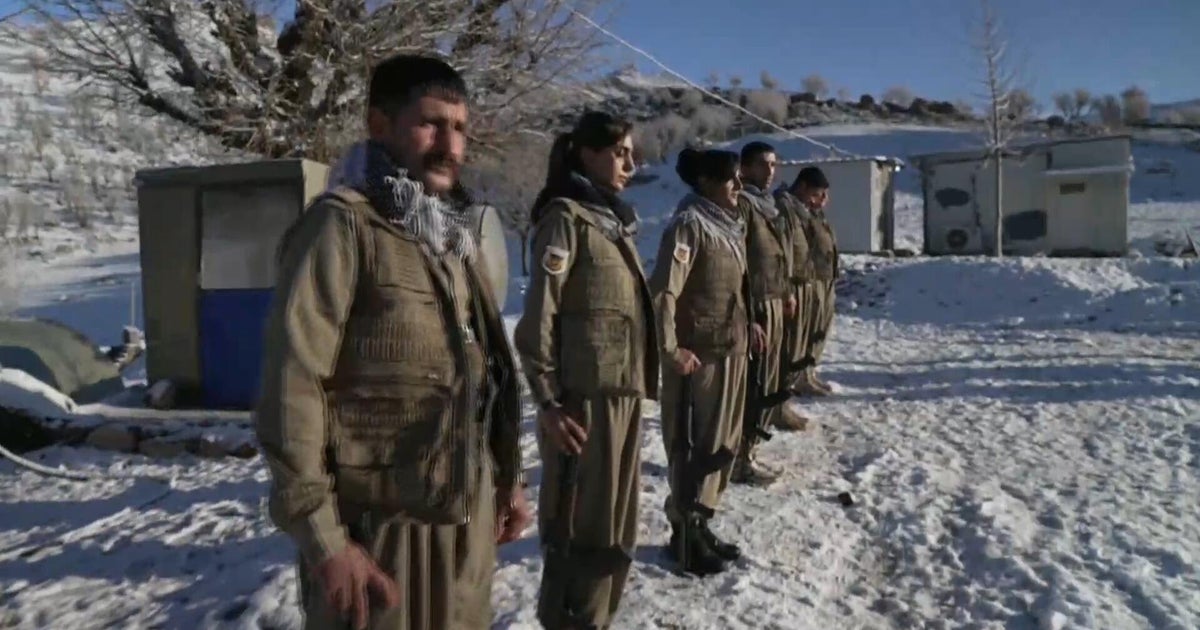
Italian Foreign Minister Antonio Tajani said there had been an attack on an Italian base in the Iraqi Kurdish city of Erbil, but there were no injuries at the compound, which also houses a U.S. base.
A Kurdish security source said drones were shot down over Erbil by international forces based at Erbil airport.
The commander of the Italian Camp Singara in Erbil, Stefano Pizzotti, told Italian television that “the type of threat is still being determined, whether it was a drone or a missile.”
Tajani condemned the attack on the base, which he said was “within a compound which includes other bases from other countries, above all Americans.”
“We don’t know if it was aimed at the Italians or at the compound in general,” he said, adding in a social media post that, “fortunately, all our soldiers are well and safe in the bunker,” though there was “some damage to the base’s infrastructure and equipment.”
CBS/AFP
An Iranian drone attack in Kuwait that killed six U.S. service members in the early hours of the war with Iran was more severe than has previously been revealed, with dozens suffering injuries including brain trauma, shrapnel wounds and burns, multiple sources told CBS News. At least one may require the amputation of a limb.
Sources described a chaotic scene in the aftermath of the strike on a tactical operations center at the Shuaiba port outside Kuwait City on March 1. Smoke quickly filled the building, making it difficult to rescue those inside.
Defense Department officials initially didn’t specify how many had been hurt in the Kuwait attack, but said on March 1 that five were seriously wounded and “several others sustained minor shrapnel injuries and concussions.”
The Pentagon has a process to notify wounded soldiers’ family members and seeks to shield them from learning from press releases about how extensive the injuries were. The military defines a serious injury as one that “requires medical attention, and competent medical authority declares that death is possible but not likely to occur within 72 hours.”
At least one American was killed in a separate strike in Saudi Arabia March 1. It is unclear how many others may have been injured in that attack.
On Tuesday, Pentagon spokesman Sean Parnell said about 140 American service members had been injured so far, without specifying where or when they were wounded. He said “the vast majority of these injuries have been minor, and 108 service members have already returned to duty,” with eight still listed as severely injured.
Military officials told members of Congress in a briefing this week that the U.S.’s war with Iran cost around $11.3 billion in roughly its first week, according to sources familiar with the meeting.
That figure is a low-end estimate and does not include the build-up costs of moving assets into place ahead of the operation’s start on Feb. 28.
The estimate was first reported by The New York Times.
Sen. Chris Coons, the top Democrat on the Senate subcommittee that handles defense appropriations, told reporters Wednesday: “I expect that the total operating number is significantly above that.”
He said it would be a “fair guess” that the war’s daily cost exceeds $1.5 billion, though it varies day-to-day depending on military operations. The cost of replacing the munitions that have been used in the war is probably “already well beyond $10 billion,” he said.
The Delaware senator said he expects the Pentagon to ask lawmakers to pass a supplemental funding package for the Iran war. He did not specify how much money he expects the administration to request.
“Before I would even begin considering something like that, they owe us an accounting of how much has been expended,” said Coons. “We did have some lengthy exchanges about that yesterday. I am not satisfied with the information I’ve got so far.”