Fresh airstrikes slammed into the southern suburbs of Lebanon’s capital Beirut on Monday after Israel warned residents of some neighborhoods to flee for their safety as it continued its attacks against Hezbollah.
Lebanese Minister of Public Health Dr. Rakan Nasr al-Din said Sunday that the death toll since the beginning of the latest Israeli operations in the country, which began along with the joining U.S.-Israeli strikes on Iran, had reached at least 394, including 83 children and 42 women. He said more than 1,130 people had been injured including 254 children and 274 women.
Tens of thousands of people across southern Lebanon have been ordered by Israeli authorities to evacuate their towns and villages, fueling a humanitarian crisis in the country.
Qatari authorities have arrested more than 300 people for sharing images and “misleading information” during days of attacks by Iran, the interior ministry said on Monday.
The people arrested “filmed and circulated video clips and published misleading information and rumours that could stir public opinion”, a statement said.
Stock markets plunged Monday as oil and gas prices soared on fears about supplies from the Middle East with the U.S.-Israeli war against Iran continuing into a second week with no sign of letting up. Investors ran for the hills as crude rocketed to its highest level since the Russian invasion of Ukraine in 2022.
President Trump has said only the “unconditional surrender” of Iran will end the war, and over the weekend he added that the spike in energy prices was a “small price to pay” to eliminate Iran’s nuclear threat, reiterating the White House’s insistence that the rise is temporary.
London’s FTSE 100 share index dropped 1.4% in the first couple of minutes of trade on Monday as investors reacted to the surge in oil prices. Earlier, stock markets in Asia fell sharply, with Japan’s Nikkei 225 index closing down by more than 5%.
In South Korea, the Kospi index sank by more than 8% at one point, triggering a 20-minute halt to trading before eventually closing down 6%.
West Texas Intermediate and Brent crude contracts both jumped around 30% to hit peaks just short of $120 a barrel. European gas prices also soared 30% Monday.
Since the beginning of the war, WTI has risen more than 75% and Brent more than 60%, though both eased on news that finance ministers from the Group of Seven industrialized nations will discuss tapping emergency reserves to ease the supply strain.
CBS/AFP
Global oil prices spiked near $120 per barrel before falling back Monday as the Iran war intensified, threatening production and shipping in the Middle East and pummeling financial markets. The price for a barrel of Brent crude, the international standard, surged to $119.50 per barrel early in the day but later was trading at $107.80 per barrel.
West Texas Intermediate, the light, sweet crude oil produced in the United States, spiked to $119.48 per barrel but fell back to $103 per barrel.
The last time Brent and U.S. crude futures traded near the current level was in 2022, after Russia invaded Ukraine.
Prices moderated on Monday after the Financial Times reported that some members of the Group of Seven industrial nations were considering releases of strategic oil reserves to alleviate pressure on the markets. The report was later confirmed by sources to other news outlets.
Roughly 15 million barrels of crude oil — about 20% of the world’s oil — typically are shipped every day through the Strait of Hormuz, according to independent research firm Rystad Energy. The threat of Iranian missile and drone attacks has all but stopped tankers from traveling through the strait, which is bordered in the north by Iran, and carry oil and gas from Saudi Arabia, Kuwait, Iraq, Qatar, Bahrain, the United Arab Emirates and Iran.
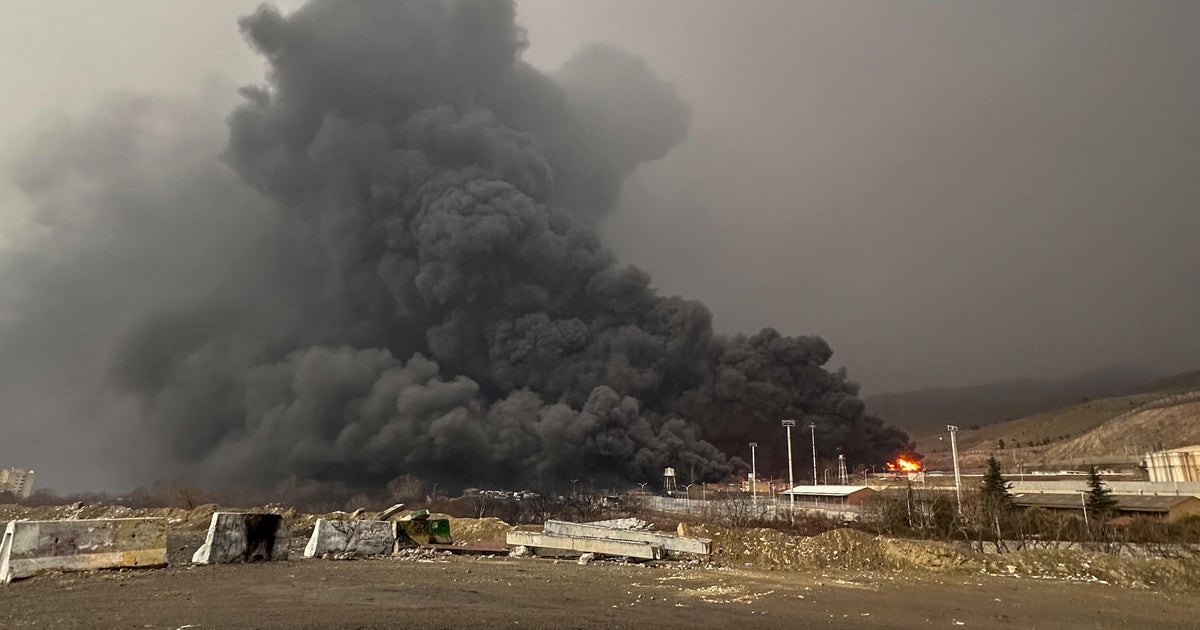
Iran, Israel and the United States also have attacked oil and gas facilities since the war started, exacerbating supply concerns.
CBS/AP
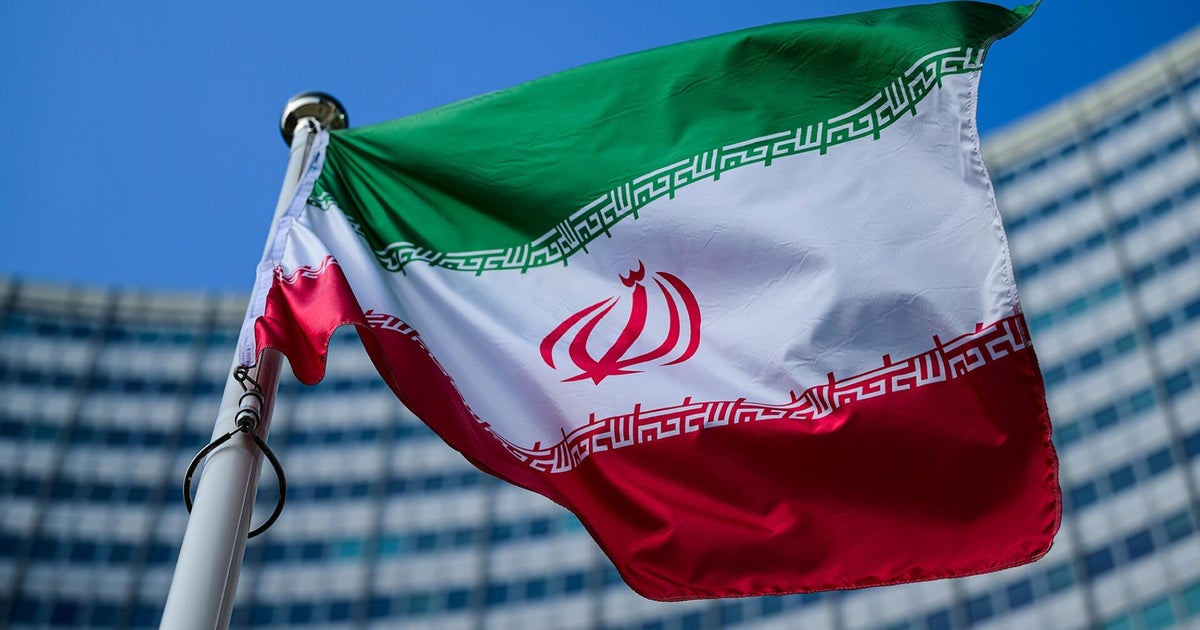
Iran’s powerful Islamic Revolutionary Guard Corps said Sunday that the country was prepared and equipped to continue waging an intense war against the U.S. and Israel for at least six months.
“The Armed Forces of the Islamic Republic of Iran are capable of continuing at least a 6-month intense war at the current pace of operations,” the country’s official Fars news agency cited IRGC spokesman Ali Mohammad Naini as saying.
Energy Secretary Chris Wright said Sunday that the “period of elevated energy prices” will be temporary, “but it will not be long,” as the Iran war continued into a second week.
Oil and gas prices “shouldn’t go much higher than they are here because the world is very well supplied with oil,” Wright said on “Face the Nation with Margaret Brennan.” He insisted there is “no energy shortage at all,” saying the U.S. is a large exporter of natural gas and although refineries in Europe and Asia are seeing “interruptions in their crude flows,” there are “massive energy stores around the world.”
“What you want is emotional reactions and fear that this is a long-term war,” Wright said. “This is not a long-term war; it’s a temporary movement.”
Wright said the U.S. still has 400 million gallons of oil in its strategic oil reserve, and “we’re more than happy to use that if it’s needed.” But he added that it’s a “logistics issue” because refineries in Europe and Asia need oil.
“We’re just doing pragmatic things to get through a short period that will that will bring in an era of even lower energy prices because a major energy-producing region of the world, the Middle East, will no longer have a strong, powerful Iran that can threaten their neighbors, that can threaten the United States of America and that was not far away from a nuclear bomb,” said Wright.
President Trump echoed the sentiment in a post on his Truth social media platform on Sunday, saying: “Short term oil prices, which will drop rapidly when the destruction of the Iran nuclear threat is over, is a very small price to pay for USA and World, Safety and Peace,” adding: “ONLY FOOLS WOULD THINK DIFFERENTLY!”
A U.S. service member has died from injuries received during Iran’s initial retaliatory attacks, the U.S. Central Command said Sunday.
The service member was seriously wounded during an attack in Saudi Arabia on Mar. 1, CENTCOM said. The identity of the service member will be released following the notification of the next of kin.
This is the seventh American service member to be killed in the Middle East since the war in Iran started on Feb. 28.
Mojtaba Hosseini Khamenei, the second son of former Supreme Leader Ayatollah Ali Khamenei, has been named Iran’s new supreme leader, Iranian state media reported Sunday.
Mojtaba Khamenei has never held elected office. But for years he has operated quietly behind the scenes from within his father’s office, cultivating influence across the security establishment, particularly within the Islamic Revolutionary Guard Corps.