We may receive an affiliate commission from anything you buy from this article.
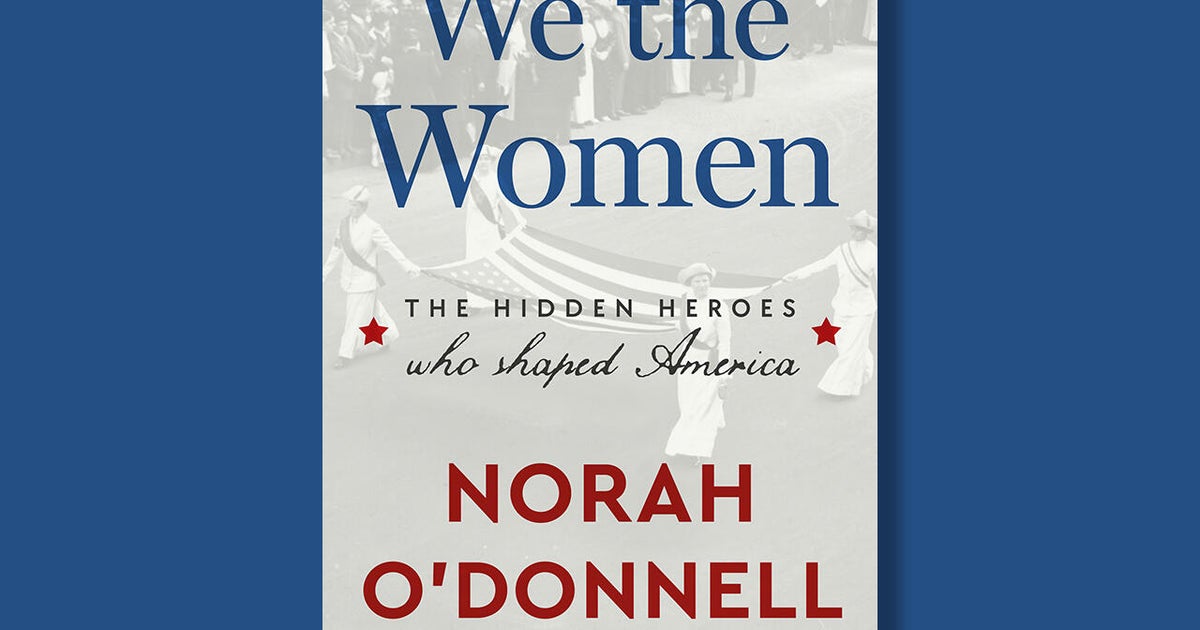
In (to be published Feb. 24 by Ballantine Books), CBS News’ Norah O’Donnell, writing with Kate Andersen Brower, reveal the often-overlooked stories of the “hidden heroines” who fought for freedom and equality in all areas of American life, from the courtroom to the battlefield, from male-dominated corridors of power, to protest movements.
Read an excerpt below, and
Prefer to listen? Audible has a 30-day free trial available right now.
On July 4, 1876, celebrations of America’s centennial were planned all across the country, with the grandest event taking place in Philadelphia. Thousands stood in the blistering sun to hear the reading of the Declaration of Independence, but a small group of women gathered in America’s birthplace had their own patriotic message to deliver.
Elizabeth Cady Stanton, Susan B. Anthony, and other suffragists from across America had been denied the right to participate in the day’s activities. Elizabeth had been told by the man in charge that the program was already full, so the women decided that they would have to storm the stage to be heard.
Outside Independence Hall, Richard Henry Lee of Virginia — whose grandfather had proposed independence from England a century earlier — read from the original Declaration of Independence, which promised equal rights. When he finished, Susan and four other women rose from the audience and marched their way to the front of the platform, which was adorned in red, white and blue for the holiday.
The crowd was caught off guard. Susan encountered no resistance, only the stunned, pale face of the presiding officer, Senator Thomas W. Ferry. She handed him their pamphlet, entitled the “Declaration of Rights of the Women of the United States,” which he begrudgingly accepted, thus making it an official part of the day’s proceedings. It was a groundbreaking, four-page list of grievances that equated women’s oppression with the treatment the colonies received by King George III.
The group of women caused enough of a stir that men in the audience stood on their seats to see what was happening. As they quickly exited the stage, they handed extra copies of their manifesto to men who eagerly reached for the documents.
The women had created their own fireworks — too much for General Joseph R. Hawley who shouted, “Order! Order!” As head of the U.S. Centennial Commission, Hawley was the man who had denied Elizabeth’s request for the women to participate. “We are crowded for time,” he had written in a letter. Those words had come back to haunt him.
Elizabeth Cady Stanton, president of the National Women’s Suffrage Association (NWSA), and her colleagues had hoped to use the occasion to highlight the hypocrisy of celebrating independence while half the population were still denied their right to vote. “We thought it would be fitting for us to read our Declaration of Rights immediately after that of the Fathers was read, as an impeachment of them and their male descendants for their injustice and oppression,” Elizabeth later recounted.
The six NWSA members who had stormed the stage then moved to the front of Independence Hall for the next dramatic moment of the day. In her memoirs, Elizabeth, described the scene:
“Here, under the shadow of Washington’s statue, [behind] them the old bell that proclaimed, ‘liberty to all the land and all the inhabitants thereof,’ they took their places, and to a listening, applauding crowd, Miss Anthony read the Women’s Declaration.”
Susan B. Anthony’s remarks began, “While the nation is buoyant with patriotism, and all hearts are attuned to praise, it is with sorrow we come to strike the one discordant note, on this one-hundredth anniversary of our country’s birth.”
Standing in the sweltering noon heat, wearing a heavy Victorian petticoat, Susan reminded the crowd that women had no right to vote, no marriage rights, no real legal protections, and were subject to taxation without representation.
“We ask justice, we ask equality, we ask that all the civil and political rights that belong to citizens of the United States, be guaranteed to us and our daughters forever.”
Our daughters forever.
This courageous call for universal suffrage, delivered on the centennial celebration of the Fourth of July, helped inspire the struggle that would culminate in the passage of the 19th Amendment more than four decades later. It was a profound American moment that helped ensure we all now have the right to vote.
***
I didn’t learn about this extraordinary day in school or from the many history books I’ve read. Why is this moment a mere footnote to our country’s story rather than a centerpiece of our lessons? Most of the history I learned in school was, well, pretty boring — or should I say more politely, difficult to relate to! But I can relate to these bold and brilliant women who had not been given a seat at the table or an equal opportunity and had to force their way to the stage.
As I learned more about these prominent suffragists, I began to wonder what else was missing from my understanding of our nation’s founding document and the centuries-long struggle for civil rights and women’s rights. I was curious about other women who helped change the course of history in America that we know little about; the hidden heroines who against all odds fought for the freedoms outlined in the Declaration of Independence and the Constitution. How did their actions lead to my freedoms today? Most importantly, I can vote. I can also own my own property and have my own bank account. I can work as a journalist and ask tough questions to people in positions of power.
Those rights were not afforded to women at our country’s founding. They had to be hard-won over the past 250 years.
“We hold these truths to be self-evident, that all men are created equal.” Those very words created this country and are the spark that lit every revolution in American history. Yet for the women at America’s centennial, more than half of the population were still denied the inalienable rights of “Life, Liberty, and the Pursuit of Happiness.” Susan, Elizabeth, and their fellow suffragists were not equal. In their declaration, they affirmed a belief in human rights for all, which they called the “corner stones of a republic.”
As you’ll learn in this book, women have never given up the fight to realize a more perfect union. The heroes in this book powerfully illustrate the 250-year struggle they have fought to achieve that better version of America. Their persistent defense of this country’s ideals at home and abroad has forced our nation to live up to its promises.
Women have bled for their country during every war in our nation’s history. Some women took a bullet for America when they didn’t even have the right to vote. Women also built this country — from bridges to banks to hospitals; and they birthed movements, not just suffrage but also the Civil Rights movement. As Harriet Beecher Stowe famously put it, “Women are the real architects of society.” Many of these great early female reformers were abolitionist leaders. Again and again, women have demanded their place, their rights and rights for others.
“We the People,” is the phrase that begins the U.S. Constitution, and it is meant to remind us all that the authority of our government comes directly from all of its citizens; that our government is by and for the people. This book is titled, “We the Women,” as a reminder of the shared struggle, the collective fight, by women and for women, to make sure that our government recognizes all of its citizens.
It’s a story often missing from our history books. The National Women’s History Museum found only 15% of what is taught in America’s schools highlights the achievements and history of women. We want to change that. This retelling of the American narrative puts women in their rightful place on the pages of history.
On a more personal note, I wonder how my own sense of self, power, and courage might have been shaped if I had learned more about these women as a young girl.
***
As America celebrates its 250th Birthday, a more perfect union is still a work in progress. Even still, the United States of America’s democratic ideals are the envy of the world. The promise of the American dream is what brought my grandmother to the U.S. in the 1930s.
Mary Teresa Monaghan O’Kane was the oldest of 9 children, a Catholic living in Protestant-controlled Northern Ireland. My grandmother started working at the age of 12 years old in a linen factory in Belfast, traveling through barbed wire and barricades every day, not to school but to a job to support her family. She never made it past the 8th grade, but she was smart enough to know she had to leave Northern Ireland.
So, she did what so many young Irish women did in the early 20th century: she garnered her courage, boarded a boat, all alone, and set sail for America inspired by a dream for a new life. The week-long, transatlantic voyage on a steam ship was notorious. James Joyce, the renowned Irish author, once described the Atlantic Ocean as a “bowl of bitter tears,” to capture the sorrow of immigrants leaving their homeland.
My grandmother arrived at Ellis Island in 1930. When she entered New York Harbor, she was greeted by the Statue of Liberty. Think about that! A woman — Lady Liberty! — holding a torch, welcoming people like my grandmother to America’s shore. What did this 150-year-old country offer a young woman? Certainly, my grandmother believed there would be opportunities for women not provided for them in Ireland.
If I could travel back in time, I’d hold my scared grandmother’s hand and say, “It’s going to be okay. Look at this bronze plaque on the pedestal of Lady Liberty.” It reads in part, “Give me your tired, your poor, Your huddled masses yearning to breathe free.” I’d say, “Grandma, that was written by young female poet. Her name is Emma Lazarus. America is the land of opportunity.”
You might think my Irish grandmother’s story is only remembered as part of my family history and yet she is recorded in America’s narrative. I found her signature in a book at the National Archives in Washington, D.C., where upon arrival in America she listed her profession as a handkerchief stitcher. She had just $20 to her name.
The bold spirit and bravery that brought my grandmother across the Atlantic lives inside the women that we feature in the book. Each woman represents the historical significance of the period in which she lived. Some of them are trailblazers, some fought in war; others fought in a courtroom, or for equality in sports and business. All of them were changemakers.
For nearly three decades, I’ve spent my career as a journalist amplifying the stories of women. This book is an expansion of that work. Our research led us to uncover some pretty astounding stories. It was a difficult process to narrow down who to feature across 250 years of American history where women’s contributions have been not only extraordinary, but often overlooked.
Mary Katherine Goddard is the only woman whose name is on the Declaration of Independence; Belva Lockwood was the first woman to argue before the U.S. Supreme Court and the first to run for president; Susette La Flesche spent her life advocating for Indigenous people’s rights; Mary McLeod Bethune’s led the Black Cabinet during FDR’s presidency; and Frances Perkins was the architect of the New Deal and the nation’s first female Cabinet member.
Many held the distinction of being the first in their field, breaking barriers like Phillis Wheatley, the first African American woman to publish a book of poems; Dr. Elizabeth Blackwell was the first woman admitted to a medical school; and Agnes Meyer Driscoll is the First Lady of Naval Cryptology. One of them was not just the first, but to this day is the only: Dr. Mary Edwards Walker is the only woman to receive the Medal of Honor, the nation’s highest military decoration.
Through this journey, I developed a personal connection to each of these women, a sense of admiration for what they endured and for the courage it took for them to keep going in the face of adversity, discrimination, and hatred. I hope they inspire you, the way they inspired me.
Our goal is not to deliver a full biography of the women we are showcasing, but to paint a picture of their grit and determination to be treated equally — not just under the law but in society. We wanted to highlight women who pushed America to live up to its founding promises: liberty, equality, and the pursuit of happiness.
We relied on historians who have made it their life’s work to rediscover these women. But we are not historians. So, if there’s something or someone missing, my hope is that you too will help share their stories. We didn’t include every famous woman you heard of; there’s no chapter on Abigail Adams, though she is a widely influential founding mother. But there is a chapter on Abigail’s friend Mercy Otis Warren, who wrote the first history of the revolution. There are many women throughout history who exemplify America’s values, and we couldn’t possibly write about all of them. We wanted, as much as possible, for each profile to feel like a gem we were uncovering — something new, and valuable, with a significant history worthy of discovery.
Each of us plays a role in the arc of history. I love that phrase. Dr. Martin Luther King Jr. said the arc of history is long, but it bends toward justice. These women have been central to bending that arc toward justice. Throughout this process, when I felt discouraged by challenges in my own life, these women filled me with sense of grit and resilience. My hope is that you, too, are inspired by their lives.
From “We the Women: The Hidden Heroes Who Shaped America” by Norah O’Donnell with Kate Andersen Brower, published by Ballantine Books, an imprint of Penguin Random House LLC. All rights reserved. No part of this excerpt may be reproduced or reprinted without permission in writing from the publisher.