You could be forgiven if you haven’t the foggiest idea of the significance of 24 Akbar Road unless, of course, you are a member of the Congress Party. This bespoke residence in Lutyens Delhi was from January 1978 till early last year the party’s head office. As Rasheed Kidwai in his book 24 Akbar Road records, seven Congress presidents presided over the party from their office in this house.
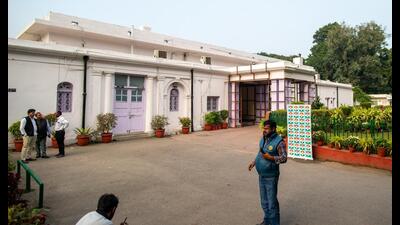
Built sometime between 1911 and 1925 by Sir Edwin Lutyens, it’s a particularly fine example of British colonial architecture. It was always considered special. When he was a member of Lord Linlithgow’s Executive Council, Sir Reginald Maxwell lived there. After independence, particularly fortunate ministers and MPs were allotted this bungalow.
As Kidwai writes of the property when the (Indira) Congress Party took it over from one of its Rajya Sabha MPs: “Facing the residence of the chief of the Indian Air Force and the Intelligence Bureau’s political surveillance unit, it comprised five barely furnished bedrooms, a living and dining hall and a guest room.” It also has a spacious lawn at the back.
For me, however, this once gracious residence is special for a very different reason. In 1960, it became the residence of the Burmese ambassador to India. Daw Khin Kyi and her young daughter Aung San Suu Kyi used to live there. At the time it was called Burma House, the name given to it by Jawaharlal Nehru in recognition of the fact that Daw Khin Kyi lived there.
Daw Khin Kyi was the widow of Burma’s national hero Aung San. After Aung San’s assassination in 1947, months before the country’s independence, Daw Khin Kyi served in U Nu’s cabinet as minister for social welfare. In 1960, she was posted to Delhi where she served as Burma’s ambassador for seven years becoming, during that period, the doyenne of the diplomatic corp. She was a close friend of my parents and her daughter Suu and my sister Kiran were at college together at Lady Shri Ram. We got to know them rather well.
It sounds like a boast but I was Madame Aung San’s — as we all called her — favourite. As Suu teased me, I was “a roly poly” little boy. I was frequently over and Daw Khin Kyi took delight in feeding me. Perhaps I reminded her of her son from whom she had parted company.
Many are the meals of khow suey that I have had in the old dining room of 24 Akbar Road. At the time, the specialty of the maison was black rice pudding. I would quaff large quantities of it. Madame Aung San would chuckle with delight whilst she watched me make a pig of myself.
At the time Suu was in her early teens and kept her hair in a plait. Though her years of politics were still decades away, she seemed to know that one day she would run the country. She was acutely conscious of what was likely to be her destiny. In 1962, she did a pencil drawing of Kiran on which she wrote, “Kiran Thapar may be allowed entry into Burma at any time.”
In addition to drawing, Suu was also an adept piano player. Madame Aung San, on the other hand, was a devout Buddhist. I often accompanied her on Sundays as Wilson, her loyal driver, would negotiate her black Mercedes to the Buddhist monasteries just beyond the Qutab. There she would regularly feed the monks and seek their blessings. I would tag along for the ride, confident that I would be heartily fed when we returned to Burma House.
I don’t know how Congress treated 24 Akbar Road. But it was a beautiful home in Madame Aung San’s days. It’s truly a house with a history, even if what I call the better part is likely to be forgotten as it recedes into the mists of time. My intention today is to recall, perhaps for the last time, those wonderful days of yore.
Karan Thapar is the author of Devil’s Advocate: The Untold Story. The views expressed are personal